Showing posts with label runny honey. Show all posts

28 February 2014

Zesty glazed salmon on butter bean mash - the week's unexpected hit!

I love butter beans and I don't mind who knows it.

Now I do know that there are folk out there for whom a butter bean is the epitome of disgusting - strange folk who need to have their eyes opened to the beauty of the butter bean when engaged in the most delicious of things - butter bean mash.

However, I am getting a bit ahead of myself, so let's back up a bit and do a bit of explaining.

I have been looking for carbohydrate alternatives.  It is just too easy to say "hmmn, pork chop.  What shall we have with it?  Oh, new/roast/mashed/dauphinoise/boiled/chipped/Hasselback (and ever onwards) potatoes".  There are so many different types of potato dish that you can choose from!  However, I think I might have exhausted my range of all known potato types and have probably cycled through them all a number of times.

So it was time to try some creative alternatives.

With that in the back of my mind, I was doing my usual thing of browsing the foodie internet for possible dinner ideas.  One dinner ingredient that we all enjoy but we just don't eat enough of, is fish.  Having discovered that Asda's range of frozen fish is compatible with several different methods of cooking, I was particularly after a fish recipe when all of a sudden there appeared a recipe that solved the two requirements in one.  Sara Buenfeld's Sizzling Salmon with Bean Mash, on BBC Good Food.

Mmmmn ... butter (or Lima) beans
Salmon - tick!  Butter beans - tick!

Even better, from a balanced meal point of view, it included wilted Rocket in the mash and the fish was grilled (albeit with a sweet mustard glaze).  Add a couple of likely looking veggies and that is dinner sorted - completely without recourse to a potato.

However, I had temporarily forgotten - in my butter beany enthusiasm - that hubby "isn't keen" on the beautiful creamy giants of the bean world.  For that, read "have yet to sample them in anything that makes them even palatable, never mind edible".  Humm.

I knew that I'd never sampled butter bean mash and I knew that I'd had it recommended to me by more than one person - and more than one of those more than one people were like hubby in their dislike for the ordinary butter bean.  However, they reported that butter bean mash was a definite thumbs up.  My caution went for a fly around in the wind and I put the dish on the menu plan.  *gulp*

Now the naughty boy has been teasing me all day with various comments about the three (THREE!) tins of organic butter beans I'd had him buy in the shopping this morning, but I held out, stood firm and went for it.


Do you know, he likes it!  No, in fact, I'd say he really rather liked it (which is a bit more than your average "like" - in case you were wondering).  We've just finished dinner and having gone from a plaintive "Well if I don't like it, what am I going to eat?" to "This is delicious!  ~suspicious look from me~  No, seriously delicious!", I call that a very definite win.

Son and heir left a little of his mash, but then I did give him rather more - hollow legs and all that.

The salmon was lovely with the lime/honey/mustard glaze and took minutes to cook under the grill.  The butter bean mash was simplicity itself, even with my changing the order of cooking around a little bit to include sauteing the garlic in the butter for a minute or two, so that I didn't get a reaction to it.  They are right in the original recipe when they say that the mash requires a good wallop of seasoning to bring out the flavours - I seemed to be endlessly adding pepper, but once you reached sufficient, you realised why.  The creme fraiche is a master stroke, as it loosens the flouriness of the beans and combines with the butter to make an overall creaminess.  Just so tasty!


I served the fish and mash with some broccoli and carrots that I drizzled with the cooking juices.  Everyone was happy with the quantity of food on the plate and I am quietly cock-a-hoop that it was as much of a success as it turned out to be.

I most definitely recommend this one.  It's a keeper!

ZESTY GLAZED SALMON on BUTTER BEAN MASH   (serves 3)

Ingredients :

3 salmon fillets, skin removed
zest and juice of 1 lime
2 tbsp runny honey
1 heaped tbsp wholegrain mustard
3 x 400g tins of butter beans, rinsed
25g butter
1 garlic clove, crushed and chopped finely
4-5 tbsp creme fraiche
50g rocket
sea salt and freshly ground black pepper.

Method :

1.   Place the salmon fillets face upwards on a heatproof flat tray.

2.  Into a bowl, combine the lime zest, lime juice, honey, mustard and a good pinch of salt.

3.  Spoon a little of the mixture onto the face of each salmon fillet, then turn each upside down and leave to marinate for a few minutes while you prepare the mash.

4.  Drain the beans and place into a flat bottomed bowl.  Using a potato masher, mash until the beans are quite broken up, but still retain some texture.

5.  Place the butter into a saucepan large enough to take all the butter beans and put it on a low heat to melt.  Add the garlic and cook very gently - do not allow it to brown - for a few minutes.

6.  Once the raw garlic smell has dissipated add the crushed butter beans, a large pinch of sea salt, a whole heap (to taste) of freshly ground black pepper and the creme fraiche.  Vigorously mix the combination together - a wooden spoon is good for this as you can crush any randomly whole butter beans as you go.  Heat the contents of the pan until bubbling.

7.  Spoon a little more glaze over the fish fillets and place under a hot grill for 2-3 minutes.

8.  Turn the fillets and spoon the remaining glaze over them, then return them to the grill until done.  The cooking juices should be bubbling and hot.

7.  Just before you are due to serve, add the rocket to the butter bean mash pan and stir through.  You are wanting the rocket to have just wilted and not be cooked.

8.  Serve with steamed broccoli and carrots, with the cooking juices from the fish drizzled over.

Printable version

25 August 2013

Oven baked honeyed rhubarb

Such pretty colours.
We have two large rhubarb plants in our garden.  I've mentioned them before, I know, but for those who are new to them, we have the original Champagne rhubarb known as Ruby - plus her daughter, Rubytwo.  I'm sure I've said before how they appear to be planning world domination and I am still of that opinion.

They occupy two planters on the edge of our patio area and currently, you can't actually see down the garden because of them.  Ruby is around 4-5 feet high and Rubytwo is getting there!  We were going to crop Ruby just before the hot weather hit us - and I'm thankful that we didn't.  The huge leaves that both Ruby and Rubytwo had grown were perfect for shading them from the unrelenting sunshine and I'm sure Ruby would have suffered if her corm had have been open to the elements.

Of course, because of the sunshine and heat, both plants lost a little bit of vigour and we didn't want to crop them until they had recovered.  Now, however, several good rainfalls have gone by and they're back on juicy form.

Good enough to eat.
So - time to get a sharp knife out there and crop some rhubarb.

I will be making rhubarb jam - as ever - but before then, I wanted to have some rhubarb to eat with Greek yoghurt, or ice cream or even cream if we've got any.  However, I'm not so keen on the stewed rhubarb approach as you lose the definition of the rhubarb pieces and just wind up with mushy strands.  Tastes okay - but doesn't look particularly attractive.

I had cooked rhubarb in the oven in the past and so decided to go down that route today.  I packed a lasagne dish with four huge stalks cut into pieces - there were several layers - and sprinkled with a little sugar.  I didn't want to use all the sugar they would need, as I had a mind to add something sweet at a later date when I could taste as I went along.  That way, I didn't run the risk of over-sweetening as you do when you're just guessing at it - as with stewed rhubarb.

The pieces stayed wonderfully whole and although the rhubarb did create some juice, being uncovered as it cooked helped to keep the juice to a minimum and so leave the pieces whole.

With Greek yoghurt - mmmmn!

Once the rhubarb was almost cool, I stirred in some runny honey and with a sudden stroke of sheer genius (if I say so myself!), added a teaspoonful of orange flower water.  Between the honey and the orange flower water, they transformed the rhubarb from something that was good, to something that was very special.  I just love how the addition of two separate ingredients can do that to food.

The four huge stalks made enough for 5-6 desserts with Greek yoghurt, cream or ice cream.  I almost can't wait until dessert.  Try it - I'm sure you won't be disappointed. I've even put some on my morning bran flakes.  Makes for a very zingy start to the day!


OVEN BAKED HONEYED RHUBARB  (serves 5-6)

Ingredients :

4-5 large sticks of rhubarb, washed and chopped into 1cm pieces
2 tbsp granulated sugar
1-2 tbsp runny honey
1-2 tsp orange blossom water.

Method :

1.  Pre-heat your oven to 160degC/325degF/Gas 3.

2.  Place the rhubarb and sugar - without any water - into the lasagne dish and toss so as to let the sugar coat the rhubarb pieces.  Arrange the rhubarb into a roughly even layer or layers.

3.  Cook uncovered in the oven for 20 minutes, then remove and give the rhubarb a gentle stir so that each piece is moistened by the juice.

4.  Replace and cook for another 20 minutes, then remove and leave to cool.

5.  When almost cool, add the honey and orange flower water and stir through gently.

Serve with Greek yoghurt, cream or ice cream.

Printable version

1 May 2013

Roasted leg of kid goat with almond & orange blossom sauce

Do you recall the Seco de chivo (or Goat with Green Peppers) that I cooked some while ago?  Well, I was talking to Jason at Farmer's Choice via Twitter about the results and how the fattiness of the stewing goat pieces wasn't to my family's taste - although I liked it well enough.

He very kindly arranged to send me a boned leg of kid goat, so that I could try a leaner cut on the menfolk and see what they thought.

The joint arrived and looked fantastic, with light marbling through the meat that said it would be succulent and tasty, without the huge lines of fat that put my menfolk off the whole thing.

I'm really dead keen to use kid goat as and when possible - and it is becoming easier to get hold of and a little bit more affordable than it was.  By rights, it should be extremely affordable, so as to avoid the terrible wastage of the boy kid goats that aren't useful to the goat milk trade.

Now this whole thing happened around the time that Yotam Ottolenghi's t.v. programme "Jerusalem" was out on television for the first time.  (It's been around again since - yes, that's how long ago this was!).  I'm sure you all know my opinion as to just how much of a god Yotam Ottolenghi is to me - and we'd been watching "Jerusalem" alternately salivating like mad and watching with our mouths wide open in astonishment at the ingredients and combinations.

So when the kid goat meat arrived, it seemed right to consult Ottolenghi's genius as to what to do with it.

I recalled seeing a completely amazing Ottolenghi recipe involving young lamb - what we'd term, here in the U.K., as "spring lamb" - and as kid goat can be treated in the same way - in cooking terms - as spring lamb, I didn't look any further.

Now, it has to be said that I was a bit hamstrung where following the recipe to the letter was concerned, as the meat should have been barbecued.  We do have a barbecue, but it had been pouring with rain for the last three weeks and seemed set to continue for the next three weeks, so being able to barbecue was unlikely.  I do have a griddle pan - and I suspect I could have used that to better effect - but hindsight is a marvellous thing, as is experience.  Having done this recipe the once, I would be a bit braver the second time around.  However, I was very conscious that I may not get the chance to use kid goat again for a while (it was really very expensive then) and just didn't want to be too robust with it and wind up making it inedible.

I opted to leave the meat in its rolled state and seared the outside using the griddle pan.  That gave us a degree of charring effect that added to the flavour - but done again, I'd cut the meat into smaller chunks and just griddle the lot (assuming I didn't have a barbecue available, that is!).  Having marinated the goat in garlic, lemon zest, lemon juice, thyme and rapeseed oil, you can just imagine the mouthwatering smells that were issuing forth from the griddle pan.  Just gorgeous.


Having seared the meat, I then oven roasted it in the same way as you would spring lamb.  I opted to go for well done - with no pink in evidence - purely because I knew that son & heir wouldn't be able to eat kid goat if it was at all rare.  He was having trouble enough getting his head around the fact that what he had on his plate was a bit of a baby goat, as it was.

Now, I will say - straight away - that my almond & orange blossom sauce was a bit of a disaster.  I admit it.  However, not in flavour - which was completely and utterly fabulous - but in texture.  I used our food processor to grind the cooked almonds - which was where I went wrong.  All it seemed to achieve is grinding a certain amount of the almonds into a virtual flour, while the remainder stayed in huge lumps.  Not good at all.  As a consequence, any liquid was slurped up by the finely ground nuts and the whole thing turned into a beautifully flavoured almond butter type mixture.  Nowhere near sauce consistency!

So - if you're considering following this recipe yourself, I recommend that you use a pestle and mortar for grinding your nuts!  At least, that way, you can be more in control of what degree of pulverisation you give them.


Now, a special mention has to go to the almonds.  Just straight almonds - not blanched - were what I used and the revelation of how they turned out after spending a few minutes in hot oil in a frying pan, was immense.  I was very tempted to just eat the lot and pretend I'd dropped them into the sink or something.  Try it sometime (not dropping them in the sink - but frying some to nibble on), even if you don't make the recipe.  Just heat up a nice oil - olive or rapeseed - and cook some almonds until they're turning golden, then toss them in something nice like sea salt or a combination of herbs and spices.   I can imagine that lemon zest and black pepper with the sea salt would be amazing.  No, it's not low fat, but yes it is good for you - especially if you use an oil that is low in saturated fat.

So, getting back to the sauce.  The alchemy that goes on, just by mixing the few seemingly odd ingredients together, is just stunning.  Oh and yes, I use the word "stunning" in the full knowledge of its meaning.  I tasted the nuts when they were cooked and they were lovely.  Very moreish.  I tasted the sauce once I'd added and combined the lemon zest, juice, honey, orange blossom water, salt & pepper and rapeseed oil - to test for seasoning - and it was just incredible, without even having had the fresh herbs included.   Once you add the mint and coriander, it just takes you to a hot and dusty atmosphere, with cool shady colonnades beneath big airy villas, the smell of donkey, dust and humanity in the air.  How does he do that?  So, as I say - stunning.


We all loved the roasted kid goat.  It was succulent, the flavour of the marinade serving to accentuate the delicate sweetness and earthiness that is uniquely kid goat.  Coupled with the chargrilled red peppers and the almond & orange blossom sauce, this is one of the most jaw droppingly good dishes I've cooked since starting Rhubarb & Ginger.  Even with a sauce that had an incorrect consistency!

I served it with a jacket potato dressed with coriander and lime chilli yoghurt, which was amazingly well suited.  The only thing I would have added would be some green leaves of one sort or another.  Ottolenghi suggest fresh parsley, which I can imagine would be very good indeed.

I would dearly love to have another crack at this one - and I'll be keeping my eye open for kid goat leg, in future!

ROASTED LEG OF KID GOAT WITH ALMOND & ORANGE BLOSSOM SAUCE

Ingredients :

1kg piece of boneless kid goat leg
2 long red peppers, cut into quarters and seeds removed
olive or rapeseed oil
sea salt & black pepper

Marinade :
  2 garlic cloves, crushed
  grated zest of 1 lemon
  45ml lemon juice
  one and a half tbsp fresh thyme leaves, woody stems removed
  45ml olive or rapeseed oil

Sauce :
  50ml olive or rapeseed oil
  80g whole almonds
  grated zest of half a lemon
  2 tbsp lemon juice
  half a tbsp of runny honey
  quarter of a tbsp of orange blossom water
  10g fresh mint, finely chopped
  10g fresh coriander leaves, finely chopped.

Method :

1.  In a large bowl combine all the marinade ingredients and season well.  Divide the goat meat into several large pieces and add them to the marinade.  Using your hands, massage the marinade into the meat and leave for a minimum of 2 hours, or preferably, overnight.

2.  Pre-heat the oven to 220degC/425degF/Gas 7.

3.  Whilst the oven is heating up, and for the sauce, heat 3 tbsp of the oil in a small frying pan and add the almonds.  Cook - stirring often - until the nuts are golden and evenly cooked.  Remove from the heat and allow to cool.

4.  Place the nuts into a pestle and mortar (or any other method of crushing them that doesn't involve a food processor!) and pulverise them until they are broken, but not powdery.

5.  Decant into a bowl and add the remaining ingredients.  Stir well and taste for seasoning. 

6.  Heat a griddle pan until blisteringly hot.

7.  Drizzle the peppers with a little rapeseed or olive oil and a pinch of salt, then cook on the griddle until charred on all sides and softened.  Set aside to cool.

8.  Place the goat meat pieces onto the griddle pan (you will probably need to do this in batches, so as not to overcrowd the pan) and sear for 2-3 minutes on each side until starting to caramelise.  Transfer onto a roasting tray.

9.  Place the goat meat into the oven for a minimum of 4-5 minutes, leaving it longer depending on how thick the pieces are and how you like your lamb.  (Use lamb as a measure for pinkness.  If you like your lamb pink - you'll like your goat pink).

10.  Once done, cover with foil and set aside in a warm place, to rest.

11.  Add the freshly chopped mint and coriander to the sauce and stir to combine.

12.  Slice the goat meat into thick slices and serve with the peppers and the sauce drizzled over the top.

Heaven.

Printable version

29 June 2012

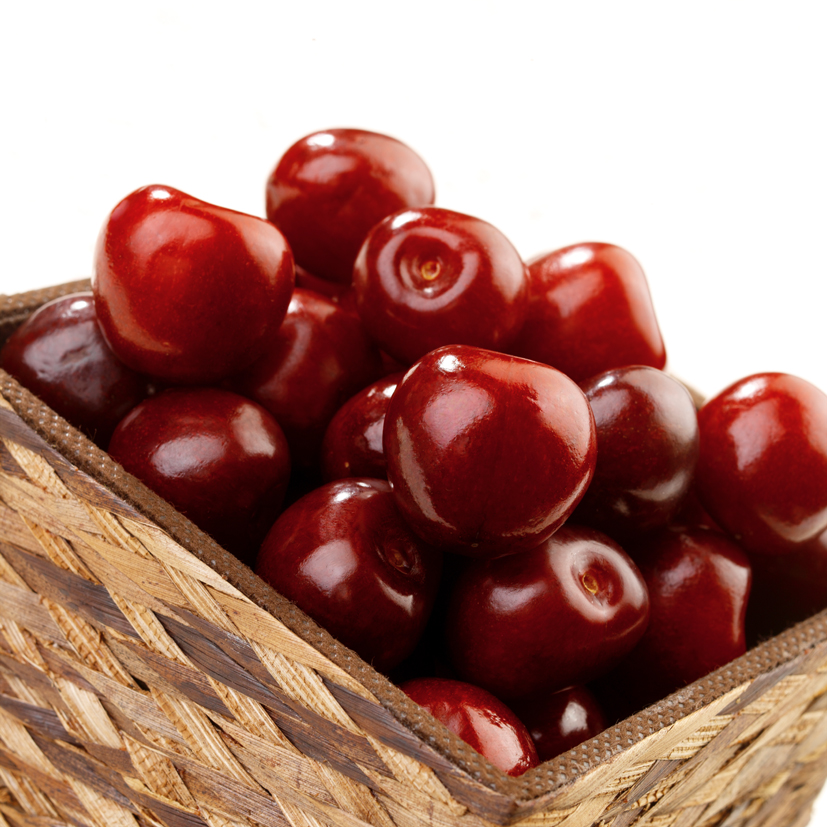
Chocolate & Cherry Pots - using Picota cherries

When I was offered a small amount of Picota Cherries to try, I didn't have to think too hard about it.  You see, we all love cherries - but hubby more than any of us.  Any cherry that comes into our kitchen isn't going to last terribly long - not even long enough to put its suitcase down and start looking for the Sangria.

So before we go any further, what makes a Picota cherry different from any other cherry?  Well, mostly the fact that it has been grown in a particular area of Spain - but I'm also reliably informed by the "Eat Spanish" website that :

"Flavor is the main distinguishing characteristic of Jerte cherries, both because of their high sugar content and the balance between sweetness and sharpness. The flesh is juicy and usually crisp. Color depends on the variety - from red juice and red flesh, to colorless juice and yellow or cream flesh. The color of the flesh and juice is usually stable, especially that of the juice. The flesh in the varieties named above is medium firm to very firm".

I have to agree with them.  Picota (Jerte) cherries are indeed crisp, sweet and a beautiful colour.  They also come without their stalks, which is something of a shame as I quite enjoy hanging a double cherry over my ears and exclaiming about my new earrings.  (Yes, well, we all have our juvenile moments).

So.  What to do with these lovely cherries, that might do them rather more justice than simply scoffing them until they're all gone and just a particularly lovely memory?

I've been wanting to make a cherry clafoutis for (probably) years now - but it seemed as though everyone was making cherry clafoutis and if you know anything about me, you'll know that I do like to be a little bit different.  I gave up dyeing my hair purple when the grey threatened to take over, so I have to make my difference in other ways these days.


On went the thinking cap and I started with the usual question of "what flavours go particularly well with cherries?".  Well chocolate was the first one to immediately spring to mind, quickly followed by alcohol (red wine, port and Kirsch, for instance) and cream.


Sounded like the bones of a very acceptable dessert, to me!


Having had a rummage in the alcohol corner - no, we don't have a wine cellar (what are you like?) - it seemed we had both red and white wine and no Kirsch, but we did have some Creme de Cassis which seemed to me to be something of a better prospect.  Kirsch can be a bit harsh sometimes, I think, whereas the softness of the blackcurrant Creme de Cassis would complement the flavour of the cherries.


Now, what about the chocolate?  Milk or dark?  Hmmmn, cherries and dark chocolate always speaks of luxury and decadence, to me.  If I was to make a mousse or a kind of ganache with the chocolate and lay that on top of some soused or macerated cherries?  Aha!  I think we have it!


Hic! You're my best mate, you are ..
So I got on with macerating the cherries by stoning them (at which point I was glad I didn't have so very many, as I don't have a cherry stoner!) and mixing them through with two dessertspoons (and a bit for luck) of Creme de Cassis.  I left them to get thoroughly drunk for the next two hours.


Next job was to make up the chocolate component, which was so diabolically easy that I am sure I shall be making this again with raspberries or clementines or any other fruit that goes well with chocolate!


Basically, it involves melting some 85% dark chocolate in a bowl over some simmering water but without stirring it more than once.  Then, set it to one side to cool slightly whilst you divide the cherries up amongst the dishes - I used glass bowls so that you could see the lushness within - and then stir Greek yoghurt and runny honey into the chocolate.  Once it is mixed through, divide up into the bowls, sprinkle with a little more chocolate and chill.


From being a soft, mousse like consistency, the chocolate sets up into more of a firm ganache type of consistency.  However, once you get a little onto your tongue it just melts and the flavour of the chocolate, with the flavour of the cherries is just beyond divine.


You get a hint of the almost smokiness of the honey, with the tang of the Greek yoghurt, all smoothed over by the unctuous chocolate, which is then washed away with the cherry juice and smooth, gentle liqueur.  Fabulous.


If you're not a person who has alcohol in the house - do not despair!  I am sure that if you were to use a cordial - cherry, blackcurrant, or even elderflower would be nice and every bit as good as the liqueur.


In the same way, if you find 85% dark chocolate to be too dark for your taste, then lighten it up a bit by using a lighter grade of chocolate - I am absolutely sure it would work perfectly.


It seems to be something of a discovery, this recipe.  Both hubby and son & heir despatched their portions with many approving mumbles and murmers - the point (in hubby's case) of the brain knowing he should have stopped eating a while ago, but the tummy saying "no! Carry on!".  It's not the best dessert for a diabetic, it's true - between the sugars of the chocolate, cherries, honey and liqueur, there's just no getting away from them.  However, at least with the use of Greek yoghurt it's not as bad as it might have been from a fat point of view.  *cough*


As an easy make and one which can be both successfully prepared prior to the event and scaled up numbers-wise, this dessert would be absolutely perfect for a meal with friends, a birthday or any get together where you want to impress.  It impressed the heck out of me, and I made it!


CHOCOLATE & CHERRY POTS   (serves 3)


Ingredients :


Sufficient cherries to cover the base of your three individual-sized serving dishes
2-3 dessertspoonfuls of Creme de Cassis
100g dark chocolate (I used 85%)
250g Greek yoghurt
2 dessertspoonfuls of runny honey
chocolate shavings to decorate.

Method :

1.  Stone the cherries (I cut them in half, but if you've a cherry stoner, use it!) and place into a bowl.  Sprinkle over the Creme de Cassis and thoroughly mix it through, ensuring that every cherry is well coated.

2.  Cover the bowl and refrigerate for the next 2 hours.

3.  Break the chocolate into a large bowl that will fit over a saucepan of simmering water, without touching the surface of the water.  Allow the chocolate to melt, without stirring.  Once well melted, stir gently just sufficient to mix it through and then leave to one side, to cool slightly.

4.  In the meantime, divide the cherries up between the serving dishes.

5.  To the chocolate, add the Greek yoghurt and the honey and stir through using a cutting and folding motion until you've a smooth mousse-like texture.

6.  Lastly, simply divide the mousse between the three bowls and top with the chocolate shavings.

7.  Refrigerate until time to serve.

Printable version


.

24 February 2012

Hot and spicy pork steaks

As I had a whole packet of Scotch Bonnet peppers left over from the Trinidadian Prawn Curry, I was alert to anything that required a chilli pepper - and Spicy Pork Steaks were on the menu.

I'm now not quite so scared of the Scotch Bonnets.  Mine are only small, so it is easy not to over-chilli just by using a half.  I am terrible for doing the "I've cut this much off, so I'll use this much, even if it's too much", because I can't bear the idea of the waste.  Which is bizarre, because if a recipe says "half a chilli pepper", then (if it won't keep nicely and it's something small) I've no compunction in throwing the other half away.  I don't understand myself, sometimes.  In fact, in this incarnation, I could easily have used the other half of the Scotch Bonnet as it was hot and spicy, but on a scale of 1-10, registered at around a 4-5.

I love pork in all its different cuts.  I am not one of these people who are put off by the presence of fat in meat and can eat a degree of fat, i.e. on a pork chop, or in slow roasted belly of pork.  Unfortunately, (for me, that is!) both hubby and son are those sorts of people, so we don't get to have pork very often as all the cheaper cuts are laden with fat.

Every so often, though, I find a recipe that will do well with the pork steaks from our local butcher and I get to have a pork fix.  I usually cut the majority of the fat from the chaps' portions and leave the fat on mine - which helps with the overall flavour and gives me a little porky fat moment.

So, when I made the Spiced Chicken Legs by Galton Blackiston recently, it occurred to me that the recipe would potentially be good with pork.  So I gave it a whirl, this week.

Regrettably, I had used up all the fresh coriander in the Trinidadian Prawn Curry (forgetting I'd need some for the pork dish), so had to think a little bit sideways.

I used Galton's recipe as a base and differed from it in that I substituted half a Scotch Bonnet pepper for the large red chillies, used orange juice because we'd run out of apple juice (that'll be the Tequila Cocktails that did that!) and included two tablespoonfuls of honey instead of the coriander.

I debated adding a little vinegar and going down the sweet and sour route, but the marinade was all getting a little bit too liquid by then (I should have reduced the amount of orange juice) so opted not to.

However, what turned out was really very nice indeed.

The marinade was certainly hot - no doubt about the Scotch Bonnet in there! - but perfectly acceptable and in the oven, had reduced down to a sticky glaze that coated the pork steaks.  When I do this one again (and there will be another time!) I will turn the steaks part way through cooking and baste them with the marinade, to take advantage of its stickiness.

The edges of the pork steaks had caramelised beautifully in the oven too, which gave a lovely flavour to both the marinade and the pork - my favourite bits!

I served the steaks with baked jacket sweet potatoes (and an ordinary potato for son & heir, who has decided he's not keen on sweet potatoes) which had a lime & chilli sour cream dressing, (made by including a finely chopped sweet red chilli & zest of half a lime plus some salt & pepper into a pot of sour cream, so couldn't be easier!) plus some garden peas.  Yummy!

HOT AND SPICY PORK STEAKS  (feeds 3)

Ingredients :

6 pork steaks
4 tbsp tomato ketchup
2 cloves garlic, grated
1 Scotch Bonnet chilli pepper, minus seeds (or 2 red chilli peppers)
1 tbsp Worcestershire Sauce
100ml orange juice
2 tbsp runny honey
sea salt & freshly ground black pepper.


Method :


1.  In a large bowl, mix together the tomato ketchup, garlic, chilli, Worcestershire sauce, orange juice and honey, to make the marinade.


2.  Dunk in the pork steaks and leave to marinade for as long as possible - at least an hour.


3.  Pre-heat your oven to 200deg C/400deg F/Gas 6.


4.  Fish out each pork steak and lay them into a baking dish.  Cover with the remains of the marinade, making sure that each steak is liberally coated.


5.  Roast for around 25-35 minutes, until the pork is tender, the marinade has turned sticky and the corners of the steaks have begun to caramelise.  It may well be worth turning the steaks and re-coating with the marinade part way through the cooking.


6.  Serve.


.

11 January 2012

Stir-fried pork with ginger & honey : another quick, satisfying supper

Harking back to the previous post (Lemony Prawn & Chorizo Rice), this is another one cropped from the Good Food Magazine.

February's magazine seems to have been a fund of interesting recipes, perhaps because the emphasis is on "healthy" instead of "expensive indulgence".  Don't get me wrong, I'm all for a bit of expensive indulgence - but after Christmas and New Year I find I start hankering for sausage & mash, or meatballs & pasta.

Well, this recipe isn't either of those - but it was completely gorgeous.

I'm always keen on a stir fry and a stir fry that involves noodles and pork?  Well immediately I'm interested.  Ordinarily, I'd have got six pork steaks from our local butcher to do this recipe.  However, having bought a pork fillet for the Ballotines, I realised that - at the moment - it's an affordably good source of extremely lean pork.  Unlike the Ballotines, if you're buying just the one fillet then it becomes almost affordable as there is so little waste.

Hubby really liked this dish - as did I.  The only tweak to the original recipe I made beforehand was the inclusion of a red pepper along with the green.  That was largely because I had a spare red pepper sitting in the fridge without a home to go to.  In retrospect, I think I would add some mushrooms to it as they would fit very well within the flavour profile and just add to the interest.

Of course, this then places the stir fry completely outside of son & heir's comfort zone.  He'll eat the pork, noodles & mange tout happily enough, but the peppers received a big negative, as would mushrooms.  In fact, I'll keep on serving this sort of dinner up to him from time to time, ever hopeful that his taste buds will have matured and he'll find the vegetables palatable.  Well, it might happen!


STIR FRIED PORK WITH GINGER & HONEY    (feeds 3)

Ingredients :

3 nests medium egg noodles
3 tsp cornflour
1 tbsp water
3 tbsp soy sauce
1½ tbsp runny honey
1 tbsp sunflower oil
500g pork tenderloin (fillet) cut into thin bite-sized pieces
1 tsp ginger, chopped
2 garlic cloves, finely chopped
1 green pepper, deseeded and sliced
1 small red pepper, deseeded and sliced
a handful of chestnut mushrooms, sliced
150g mange tout
1 tsp sesame seeds.

Method :

1.  Bring a large pan of salted water to the boil and cook the noodles according to the pack instructions.

2.  Mix the cornflour with the water, soy sauce & honey and set aside.

3.  Heat the oil in a wok or deep frying pan over a high heat until it’s as hot as you dare.  Then add the pork and cook, stirring regularly, until browned all over.

4.  Add the ginger, garlic, peppers, mushrooms and mange tout and cook until the peppers are demonstrably softened.

5.  Reduce the heat, then add the soy and honey mixture, stirring until the sauce bubbles and thickens – which will be just a moment or two, so don’t leave it!

6.  Add the drained noodles and toss to combine, then serve adding a sprinkling of sesame seeds at the last minute.

.

1 February 2011

Mustard & Lemon Sausages

The fact that I got hold of this recipe is entirely down to the power of Twitter.

There I was, quietly reading everyone's input to my timeline, when up came a comment from the lovely @madamding about how she was intending on having a Nigel Slater recipe that evening, for "Mustard & Lemon Sausages".  Well, that intrigued me as I'm always in the market for a new sausage recipe.


Very graciously, she provided me with a link to where the original recipe was to be found so that I could decide whether to give it a go.  Having read through the incredibly simple ingredients list and method, it became one of those "just has to be done" recipes.  This is mainly because I have a quite similar and delicious recipe for Gammon steaks, which involves Whole Grain Mustard and Orange zest and juice.  (Which can be found here).  This recipe involves the same Whole Grain Mustard, but with honey, Dijon mustard and lemon juice.

Regrettably, because of personal commitments, Mrs M (@madamding) couldn't do the recipe when she was intending to, so I'm hoping very much that I've not beaten her to it where blogging it is concerned!

Anyway, fingers crossed and here goes.  "Mustard and Lemon Sausages" is a wonderful dish on all sorts of levels.  The sauce/glaze begins life being incredibly acidic, but undergoes some magical transformation as the sausages cook and the mixture reduces.  Out goes the acidity and in comes a lovely soft richness, with a rounded sweetness that isn't too much.  It may sound a tiny bit odd, but I found the sauce/glaze goes extremely well with mashed potato - so a forkful that comprised of a piece of sausage, a dollop of mashed potato and a swoop of sauce is just delightful.

However, one of its very great attractions is that it will be able to join my battalion of "quick and easy" dishes, which as a disabled cook, are always good to have up your sleeve for those not-so-good days.

Needless to say, I've tweaked the recipe a tiny bit.  However, it's just the quantities of the mustard that I've changed, in order to render it a bit more affordable when you've just spent an arm and a leg on two jars of (fairly) expensive Maille mustards, instead of your usual fare of Supermarket own brand and the quantity of honey, with a view towards the mildly diabetic in the family!

Oh yes, and I'd recommend using just a plain pork sausage, as I think you'd find some of the fancier flavours would clash.

MUSTARD & LEMON SAUSAGES  (Original recipe by Nigel Slater : feeds 3)

Ingredients
 

8 plump pork sausages
2 heaped tsp grain mustard
1 heaped tsp smooth Dijon mustard
3 heaped tsp runny honey
1 lemon, juiced

Method
1. Pre-heat the oven at 200C/400F/Gas 6.

2. Put the sausages in a roasting tin large enough to take them in a single layer. If they overlap, they won’t cook properly.

3. In a bowl mix the mustards, honey and lemon juice. Stir well and pour over all the sausages.

4. Bake for 25-30 minutes, rolling the sausages over in the honey and mustard mixture once or twice during cooking, so that they eventually take on a sticky, glossy coat.

Serve with mashed potato, sugar snap peas and carrots.

.
Related Posts Plugin for WordPress, Blogger...