Showing posts with label King Prawns. Show all posts

18 March 2017

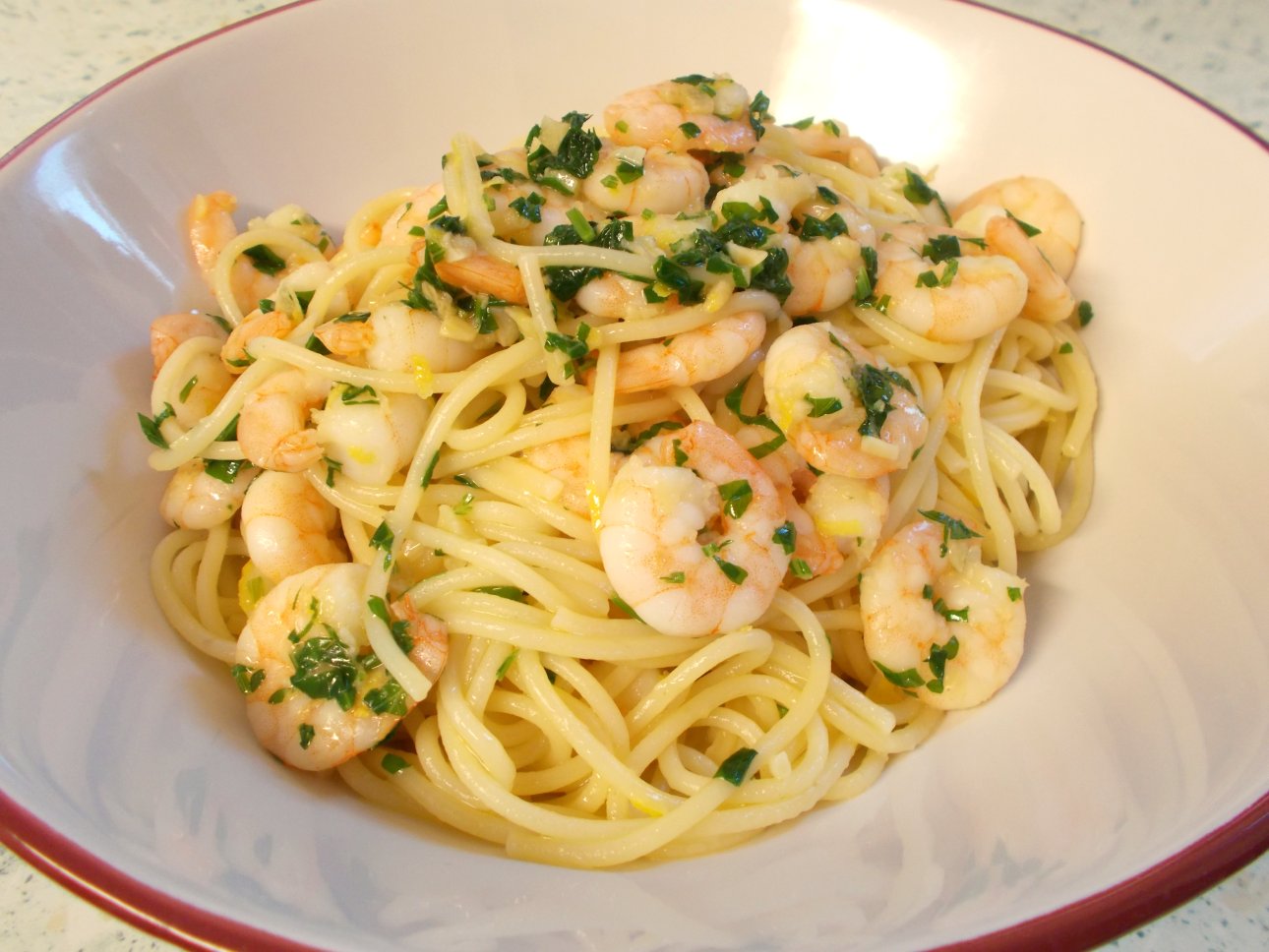
Simple garlic butter prawn spaghetti

Well, this one was a real unexpected surprise.  I wasn't supposed to be cooking this recipe at all and in fact, can't remember why I wasn't cooking the intended one.  Whatever the reasons were - and it could be any number of them! - I decided to go for this because it looked simple and sounded like it could be rather good.

Yes, it's certainly simple - both in number of ingredients, cooking process and method - and as for "rather good", well that's a bit of an understatement.  It turned out to be very good indeed.

The recipe originates with the BBC Good Food website and I could just direct you straight there, however, it occurred to me that if we ever lost that site, I'd lose a very useful and tasty recipe.  So here it is, with thanks to BBC Good Food for the original.

There is only one Cook's Tip for this recipe - and that is, if you are using cooked King prawns (or Tiger prawns), then literally just heat them up in the pan.  Don't cook them, as they are already cooked and will become tough and hard if heated for too long.  They just need to be brought up to a good temperature so as to avoid any risk of encouraging bacteria by half-hearted warming and that's all.


This dish certainly doesn't have big, bold flavours.  However, if you're into garlic butter, lemon and prawns, then you will love it.  The spaghetti gives it that comfort food thing and the lemon prevents the butter from becoming too rich.  I'd have it again tomorrow, I liked it that much!

SIMPLE GARLIC BUTTER PRAWN SPAGHETTI    (serves 2)

Ingredients :

250g dried spaghetti
sea salt
20g salted butter
2 cloves of garlic, chopped finely
a pinch of ground black pepper
250g cooked King prawns
zest of 1 lemon
15g fresh parsley, chopped.

Method :

Firstly, bring a large pan of salted water to the boil.  Add the dried spaghetti and cook to manufacturer's recommendation.

In the meanwhile, melt the butter in a frying pan over a gentle heat and add the chopped garlic.  Sweat, as opposed to fry, the garlic ever so ever so gently until the pieces are softened, adding the black pepper along the way.  Then, add the prawns, the lemon zest and the parsley and increase the temperature just slightly, sufficient to heat the prawns through without cooking them and without frying the pan's contents.

Drain the pasta and add to the prawn & garlic pan.  Toss the pasta in the garlicky butter and serve into warmed bowls, sharing the prawns out evenly.

Printable version

23 August 2015

Reviewing Malay Taste - Nasi Goreng paste

I got chatting on Facebook the other day to the very lovely Jack from Hungry Communic-ations, about Nem Viet and their range of Vietnamese food products.  During the conversation he mentioned that Nem Viet has two sister product ranges, being Malay Taste and Thai Taste and I have to admit, that I dropped huge hints about maybe reviewing some of the products on the blog.

Well, this is the first of said reviews.  *chuckle*  With many thanks to Jack for taking me up on my ever-so-slightly embarrassingly overkeen offer.

As soon as I saw a Nasi Goreng paste was in the box, I knew what we'd be sampling first.  My dedication to a good Nasi Goreng is well documented on this blog and in the spirit of same, let me just direct you to my own home-made version which you'll find here.


Even though there is a perfectly reasonable Nasi Goreng recipe on the side of the jar, I am so keen on the stuff that I couldn't bear it not to carry some of the flavours that I know it should.  Hence, I followed my own recipe, but instead of using red Thai chilli paste, I used the Malay Taste Nasi Goreng paste.

Now, ordinarily, I don't use either oyster sauce or tomato paste in my Nasi Goreng but they are in the Malay Taste paste so I was interested to see how it would shape up with these two new flavours.

I added dark soy sauce, rice wine vinegar and fish sauce to the Nasi Goreng paste which helped to ensure that the flavours that I remembered so well were there.  However, I wasn't keen on the addition of tomato paste to the Malay Taste Nasi Goreng paste.  I felt that it was something of a Westernised copout.  I definitely missed the Thai lemongrass flavours and to add that in and either no tomato paste or just a little, would have improved the product no end.

Still, for all that, I liked it.  No, I really did!  If I was to give my own home-made Nasi Goreng marks out of 10, it would be a 10 (naturally).  The Malay Taste Nasi Goreng would come in at a good 8.5 by comparison.  Just lost a couple of points for the tomato paste and no lemongrass.

The chilli flavour is really good.  It doesn't knock your head off, just builds to a nice heat and keeps on a steady course instead of constantly increasing until you can't stand it any more, as lots of them do.  I like the oyster sauce addition, it gives it a deeper flavour profile than just fish sauce would have.


If I had have gone to someone's house for dinner and they'd have served Malay Taste Nasi Goreng, I wouldn't be disappointed.  It's different to mine, but it's still Nasi Goreng and that definitely floats my boat.

You can find out where to buy Malay Taste products from their website, on the "Where to buy" page.  One of the outlets is Amazon UK, so you've no excuse not to try them!  Currently there is just the Nasi Goreng kit available at around £2.50 for the one (you have to buy 6 in one go, so maybe get some for all the family or add the neighbours in!).


I'm very much looking forward to trying the other products now!

22 February 2013

Hot Punjabi King Prawn Curry - and it is hot, too!

Sometimes, a recipe just works so well and is so tasty, that it needs to be blogged ahead of the queue.  This is one such.

I found this recipe in the latest BBC Good Food magazine and you can find the original recipe - which deals with raw King Prawns as opposed to cooked King Prawns - if you click here.  The recipe apparently comes from a lady called Jagdish Kaur who hails from the Punjab'n de Rasoi cafe in Edinburgh.  I liked the recipe as it looked awfully easy to make (which is always a good thing) and had interestingly few ingredients.  So many curry recipes have ingredient lists as long as your two arms, that it was intriguing to find one working along such minimalist lines.


I won't deny that the notion of using three live chillis and some dried chilli flakes caused several ominous gyrations of my stomach, but the "Taste Team Comment" indicated that the heat was agreeable.  However, in the interest of self preservation I changed one of the chillis to a milder red version and removed all the seeds from it.


I also included a little fish stock - in my case, the lovely Essential Cuisine fish stock and have reflected these changes in the recipe below.  I think that adding just water to a recipe is often missing a golden opportunity to inject a little more flavour.  I accept that, in some curry recipes, the addition of stock would be inconsistent with the integrity of the style.  However, in this instance it worked very well.

In fact, we very nearly didn't have the curry at all.  I completely forgot about marinating the prawns on the night before and again first thing the next morning.  Even worse, we had a breakdown in communications and only got one bag of prawns out of the freezer, needing to defrost the remaining pack at the last minute, in a sieve, under the tap!  So, it may be worth bearing in mind that the marination of my prawns only took place for around a half an hour!  Oops!


The actual cooking of the recipe lived up to my expectation and was easy peasy.  I think it took longer to chop up the onions, tomatoes and coriander, than it took to do the cooking.

One cook's note that is worth bearing in mind, is that once the water is added it is worthwhile cooking the sauce until all the water has evaporated and the sauce is really thick - which is contrary to how the original recipe goes.  The reason for this is because as soon as you add the yoghurt and prawns, the yoghurt is going to melt to a certain degree and - no matter how well you've dried the prawns - they're going to release moisture.  If you haven't reduced the sauce to begin with, you're going to land up with a really dilute sauce which if you then try to reduce, you'll end up with rubbery prawns and split yoghurt.  Not good!  So make sure your sauce is reduced as far as it can go, before you add the marinated prawns.


Very definitely a hit with the family, I'll be making this again - perhaps with chicken next time.  Hubby declared it the best curry he'd had in many a long year (which is enormous praise, especially considering he was concerned about it turning to "pond water").  Son and heir didn't say anything, just sat stolidly moving his spoon from plate to mouth until it was all gone.  I think he liked it.  For me, I loved the flavours that were bright and fresh - and although the chilli effect made my nose run and the tip of my tongue hurt, I'd have it again tomorrow - and you don't get to say that about every recipe you make!

HOT PUNJABI KING PRAWN CURRY   (serves 3-4)

Ingredients :

For the marinade

600g cooked, peeled king prawns
6 tbsp full fat natural yoghurt
2 green chillies, finely sliced, with seeds
half a tsp of sea salt. 

For the curry

2 tbsp sunflower oil plus 2 tbsp rapeseed oil
half a tsp of cumin seeds
2 medium onions, finely chopped
1 tbsp finely chopped garlic
1 tsp turmeric
1 red chilli, finely sliced
2 tsp Garam masala
2 medium tomatoes, roughly chopped
half a tsp of sea salt
half a tsp of fish stock powder, or half a fish stock cube
half a tsp of dried red chilli flakes
2 tbsp fresh coriander leaves, finely chopped.

Method :

1. For the marinade: Rinse and drain the prawns.  Pat them dry and put into a non-reactive bowl.  Add the yogurt, chillies and ½ teaspoon of salt.  Mix well, cover and marinate overnight in the fridge.

2. For the curry: Pour the oil into a deep sided wok or frying pan and set it over a medium heat.

3. Once the oil is hot, spoon in the cumin seeds, swirl and brown for 10 seconds.  Add the onions and sauté for about 10 minutes, or until golden all over.

4. Add the garlic, reduce the heat to low and stir and fry for 2 minutes.  Mix in the turmeric and stir for 1 minute.

5. Add the red chilli, increase the heat to medium and stir for 1 minute.  Mix in 1½ teaspoons of the Garam masala and stir for 1 minute.

6. Add all of the tomatoes, a pinch of sea salt and the chilli flakes.  Cook until the tomatoes have broken down, then add 120ml boiling water and the fish stock powder or cube.  Stir to combine.  Allow the curry to boil and reduce until all the extra liquid has gone and the sauce is really thick.

7. Stir in the prawns and their marinade plus the chopped coriander and cook over a high heat until they are heated through.

8. Sprinkle the remaining Garam masala over the top and stir.


Serve.

Printable version

19 May 2012

Smoked Cod Koulibiac

First of all, what is a a Koulibiac?  Well, in my Mum's time, it used to be known as "Russian Fish Pie" and is a combination of fish (most recently, involving salmon) in a sauce, encased in flaky or puff pastry.

I have seen photographs of what purports to be a Koulibiac, but which looks more like a Salmon En Croute.  For me, what defines a Koulibiac is that the pastry is used to create a pyramid shaped pie, rather than simply being rolled around the piece of fish.  I've certainly never seen an En Croute dish that ever looked like a Koulibiac!

In my view - and I accept, I might be in error in this belief - smoked fish is integral to a Koulibiac.  Certainly the only ones I've ever made have included smoked cod or haddock.  Other ingredients after that depend entirely upon whatever you fancy including - although a choice of either prawns or hard boiled eggs also seems to be traditional.

All sealed and ready to bake
The Koulibiac which hubby made for us last Sunday, involved smoked cod, king prawns and queen scallops.

You would be forgiven for wondering how we managed to finance such an exotic mix of fish - but in truth, you don't need a huge amount of the smoked fish (especially if you're including other seafood), we had half a bag of king prawns left over from another dish - and four queen scallops isn't very expensive at all.

It was hubby's first ever go at making rough puff pastry and he'd be the first to admit that it didn't go exactly to plan.  He is is own worst critic however - and I can tell you that it was so close to being perfect that I'm sure another go would have the method down pat for him.  Hence, if you are looking at the photographs and wondering about the pastry - well that's what happened.

See that teensy piece of scallop coral?  Gorgeous!
However, if you want to have a go at cooking this recipe - and why wouldn't you, it's gorgeous - I am quite sure that shop bought puff pastry would do an admirable job for you. 

It is important with this recipe to make the sauce ahead of time, so that it has time to cool.  Believe me (because I've tried), it is not easy to encase hot sauce in rapidly melting pastry.

There's just something so moreish about smoked fish in a softly flavoured white sauce - let alone finding luscious king prawns and a scallop along the route - that just floats my boat.  Russian fish pie or Koulibiac - call it what you will, it will always be a favourite for me.

SMOKED COD KOULIBIAC  (feeds 4)

Ingredients :

500g pre-prepared puff or flaky pastry
1 egg, Beaten
2 eggs, hard boiled (optional)
300g smoked cod or haddock fillets
200g king prawns
4 queen scallops , corals removed and chopped
60g unsalted butter
60g plain flour
1 onion, halved
2 bay leaves
a pinch of nutmeg
1.5 pints semi skimmed milk
handful of chopped parsley.

Method :

1.  For the sauce :

Place the milk, onion, nutmeg and bay leaves in a saucepan and bring to a gentle simmer.
 
Cut the smoked fish fillets in half so that they fit the pan easily and then poach them in the milk for three minutes.

Carefully remove the fish and the bay leaves from the milk and place into a bowl before covering and setting aside.  Remove the onion from the milk and discard.

Next, melt the butter into a saucepan before adding the flour.  Incorporate the flour into the melted butter with a wooden spoon, to form a thick roux paste.  Allow the flour to cook out for a few minutes, taking great care not to let it stick to the base of the pan.

Once the roux has turned a nice pale golden, add a little milk and stir vigorously to mix.   The milk will vanish almost instantly into the roux, at which point, more milk should be added.  Continue this process until the mixture resembles a very thick (and probably fairly lumpy) sauce.

At this stage, add the chopped scallop corals and swap your wooden spoon for a balloon whisk and continue adding more milk to the sauce.  Keep whisking and adding more milk until you have a smooth, velvety, but thick white sauce.  Remember that the seafood will release liquid into the sauce during cooking so take care not to make the sauce too thin.

Carefully fold the bay leaves and smoked Fish into the sauce, trying not to break the fish up too much, before leaving to cool to room temperature.  Once cooled, add the cooked prawns and the chopped, hard boiled eggs (if you're using them) to the mix before assembling the Pie.

2.  For assembly of the Koulibiac.
 
Roll the pastry into a square, roughly 7mm thick.  Lay the rolled pastry onto a sheet of baking parchment and brush the edges of the pastry with beaten egg.  Now form your saucy fish mixture into a high pile in the middle and place the four scallops on top in such a way that each quarter of pie has a scallop in it.  Now draw the four points of the pastry square to the middle, forming a four sided pyramid shape. Crimp each pastry seam shut before egg washing the whole pie and transferring to a large baking sheet, parchment and all.

Bake in a pre-heated oven at 180degC/350degF/gas4 for 45 minutes and then allow to cool for five minutes before serving.


.

10 May 2012

Kari Udang - Malaysian Prawn Curry

When you're a food blogger, recipes come to you by all manner of means.  There's the obvious ways, like via someone else's blog, or by a recipe site such as the great BBC Good Food.  Then there are the rather less obvious ways, such as when someone tweets you to say they've seen a great recipe they thought you might like and point you in the right direction.

Then there's the totally obscure.

Now, I was born in Malaysia and have a marked partiality towards any generic type of Malay recipe.  It's difficult to achieve true "generic" Malay recipes, because - like the U.K. - there have been so many culinary influences over time, that the genuine Malay foods have been rather bastardised over time.  However, when I see a recipe that purports to be genuine Malay, it makes me prick my ears up.

I've recently been promoting the blog gently via LinkedIn (where I'm Jenny Davies, if you're interested in connecting) and was contacted by Gopalasamy Balakisnan who recommended I visit his website www.malaysiaspice.biz where it goes under the name of The Spice Traders.  Just the name was enough to pique my curiosity, but while I was there and having a look around, I came across their Malaysian Recipes page.

There are quite a few recipes that sounded quite a way out of my comfort zone for cooking, but I thought if I investigated the "curries" page, that I might find something that would be a measure of the remainder.

The sauce, prior to adding the prawns

Which is how I came to find the Kari Udang.  (Are you still with me?).  The recipe came care of Mrs.Gandhiri Perumal, which okay I'll accept could have been a made up name just to make it look authentic, but you have to ask yourself why they'd bother to do that.

I liked the sound of the recipe, so onto the menu plan it went.

This curry is very definitely out of the run of the "ordinary" types of curry that I have made in the past.

It uses two different types of sliced onions, at different intervals.  Plus potatoes, aubergine and fresh tomato, along with an exciting list of spices such as mustard seeds, fenugreek, curry leaves and tamarind pulp - along with the prawns.  Now most of the spice list I had in the cupboard already, but I needed to find fenugreek and curry leaves.  Our local supermarket has been known to have curry leaves, because I've definitely bought them there in the past - but didn't appear to have any fresh when we went.  However, in the world food aisle, hubby pounced on a bag which appeared to say "Curry leaves" and all was well.  The fenugreek was a simple matter as they had great boxes of the stuff (which smells adorably like new mown grass).

I couldn't be doing with grating fresh coconut, so used a carton of coconut cream instead.  I suspect there wasn't much difference in the two!

The curry, ready to serve

So there I was, happily following the recipe and adding this, adding that, stirring and observing the dish as it changed and developed.  Until it came to adding the curry leaves - 10 or so - which turned out to be Bay leaves!  Oh no!  As hubby said - he would go and buy the one herb that we're never likely to need, as we have a beautiful bay tree in the front garden!  Which is why our Kari Udang was completely bereft of curry leaves.

Now I can't imagine that it would have made all THAT much difference to the eventual end flavour of the dish - certainly not where hubby was concerned, as he didn't like it at all.  Son & heir and I loved it and ate every little bit - son & heir even ate his Dad's helping.

If I were to make this again, there are a couple of points that I'd observe - and which I've taken account of in the recipe below.  One is to remember to find curry leaves, as they're there for a reason.  The other is to steel myself to hold out until the VERY last minute to add the cooked prawns, so as to prevent their becoming overcooked and rubbery - and decanting all their juice into the curry sauce, which watered it down too much.  Of course, using raw prawns would solve the problem - but then they're much more expensive.

I loved the lighter, fresher feel of this curry.  For all that it contained a complete carton of coconut cream, you could be forgiven for not knowing as the sauce was not heavy or cloying at all.  I think the addition of the large pieces of tomato helped where this was concerned.  I really enjoyed having a flavoursome curry that wasn't too frisky where spicy heat was concerned, but one that demonstrated so many different flavours in the same spoonful.

Don't be put off by the long ingredients list - as many of those ingredients will keep for a long time and thus can be used in other curries.  For instance, the tamarind pulp - I have had our block of tamarind for some months now and have found it keeps perfectly well in the larder cupboard (well wrapped, of course).  I try to bear my ingredients cupboard in mind when deciding on recipes to try, in that I'll pick a recipe that I have the majority of ingredients in stock already.  This makes best use of larger packs of herbs and spices and prevents your racing all around town every couple of days, looking for obscure ingredients.  Although, having said that, I'll be keeping my eyes open for curry leaves in the future!

KARI UDANG (Malaysian Prawn Curry)    Serves 3

Ingredients :

2 tbsp groundnut oil
1 large onion, sliced thinly & another, sliced thickly - used at separate intervals
a pinch of mustard seeds
half a tsp of fenugreek (mine was chopped leaves)
150g potato, peeled and diced small
half a tbsp tamarind pulp (I used dried, mixed with 1tbsp water then strained)
1 clove garlic, chopped
2 fresh green chillies, chopped finely
1-2 tbsp mild curry powder
10 curry leaves
sea salt
1 small aubergine, sliced thickly and cubed
250ml coconut cream (I used Blue Dragon)
2 large flavoursome tomatoes, cut into wedges

300g frozen King Prawns, defrosted (fresh would work as well, just add them much earlier in the process)
cooked white rice to serve, along with chapati or roti.

METHOD :

1.  Heat the oil in a wok and add the thinly sliced onion, mustard seeds, fenugreek and potato cubes.  Saute until the potato are almost cooked and the onion has browned.  Set aside.

2.  Add the tamarind juice to the wok, along with the garlic, green chillies, thickly sliced onion, curry powder, curry leaves and 100ml or so of cold water.  Stir and cook until heated through and fragrant.


3. Add the aubergine and simmer until the aubergine is all but cooked.


4.  Add the coconut milk, the reserved onion/potato mix and tomatoes.  (If you are using raw prawns, now would be a good time to include them).  Cover and simmer until the sauce has had a chance to combine and the tomatoes have lost their rawness.


5.  Milliseconds before you are due to serve, drop in the prawns and simply heat them through.  Do not be tempted to leave them longer than is absolutely necessary, or you will find your carefully crafted sauce begins to lose its consistency.


Serve.


Printable version
.

16 April 2012

Prawnsotto - King Prawn Risotto - is a little bit special.

So there we were, one evening before Easter, pondering on what to have meal-wise over the Easter period.  Did we really want to go down the big roast dinner route, or should we take things a bit more leisurely?  Did we even want to cook at all, or should we have a giant High Tea?  

Every suggestion had its own merits but we at least decided that, as we weren't entertaining any family, we'd not go for the big roast dinner.  We would approach Easter Sunday's mealtime with every intention of making it relatively easy, stress free - but tasty.

Well, that was the brief.  Now all we had to do was think of something to fit!

The first thing to consider was the weather.  We were in the middle of a warm spell, so something involving salad was an idea - right up until hubby mentioned one of his risottos.

Now I always perk my ears up at the suggestion of a Risotto .  One of my favourite meals, pre-risotto making days, was "Rice'n'stuff" - which was a risotto-type meal of some meat or another mixed with a number of vegetables, made in one pan with rice.  So not a risotto - but very nearly!

What sort of risotto could he make, that would acknowledge the "specialness" of Easter Sunday, but not be so totally over the top as to be diabolically expensive?  We thought back to our favourite risottos.  The Asparagus & Prosciutto, Bacon & Brussels Sprout, Bramley Apple Bacon & Black Pudding and Roasted Butternut Squash with Goat's Cheese were all fabulous, but then we remembered a King Prawn Risotto that hubby had made.  It didn't find its way onto the blog because we forgot to take photographs of it.

We'd found our Easter Sunday dinner.

With the addition of a red pepper that had been looking for a job to do for some time, plus helping hands from various herbs that we are growing in the garden, the idea of a gorgeously unctuous, tasty risotto with huge prawns just bursting with succulence?  Well, it had to be done.

So, the next time you're looking for a celebration dinner but don't want to spend hours tending to a big roast - remember the humble King Prawn and its beautiful risotto.  You won't regret it.

PRAWNSOTTO - King Prawn Risotto    (Serves 3-4)

Ingredients :

300g Arborio rice
400g cooked & peeled King Prawns, rinsed and well drained onto kitchen paper
30g butter
3 tbsp Olive Oil
2 banana shallots (or 4 normal ones) very finely diced
1 red pepper very finely diced
30g Parmesan finely grated
1 clove of garlic
1.5 litres fish stock, kept hot
200g petit pois (defrosted)
half tsp dried basil
half tsp dried oregano
half tsp dried dill
pinch smoked paprika.

Method :

1.  In a large saucepan, melt the butter into the olive oil before adding the shallots, red pepper and garlic.  Sweat these together gently, until the shallots are soft, taking care not to colour them.

2.  Once this stage has been reached, turn the heat up and get the mixture to a good sizzle before adding the rice.  Stir the rice quickly, making sure to get each grain well coated in oil and butter and getting the whole mixture as hot as you dare (careful not to burn the pan) before slooshing in a good ladleful of hot stock.

3.  You should be able to hear each grain of rice heave a collective sigh of relief.  Now add the basil, oregano, dill and paprika (note, if using fresh herbs then use 1 tsp of each).   In the time honoured way of the risotto, keep the rice moving and add another ladleful of stock whenever the mixture starts to get too dry.

4.  Take six of the prawns and chop them finely using a sharp knife.  Once the risotto has had four or so ladlefuls of stock, add the minced prawns to the mix and then continue the stirring and adding of stock when needed.

5.  After about twenty minutes or so, the risotto will be nearly ready.  The rice should be almost cooked through but still al dente and the sauce should be smooth, velvety and 'oozy'.  At this stage, the peas and the prawns can be added and mixed in thoroughly to heat through. 

6.  Finally, add the parmesan, take the pan off the heat and leave to relax for a couple of minutes.

Serve onto hot plates, garnished according to your own taste, with a light salad.

.

23 February 2012

Trinidadian Prawn Curry - some like it hot!

At last!  I put the Trinidadian Prawn Curry on the menu list - and actually got to make it.

Having done so, all I can say is "wow!".  "Some like it hot" is about right - this stuff is almost dangerous, it's that hot.  I know my hubby will be saying to himself "well it wasn't THAT bad - I could have gone a bit hotter", but for me it was right on the edge of being too hot (spicy hot, that is!).  Having had a little taste of the final product just before serving, I wouldn't have been surprised if it had melted the plastic serving spoon.

Mind you, having said that, it wasn't an aggressive heat.  The chilli effect (a combination of ginger, black pepper, medium curry powder and Scotch Bonnet pepper) was certainly well rounded and didn't immediately grab you by the back of the throat and threaten to throttle you.  It developed in your mouth and those different sources of flavour seemed to affect different taste buds.  I thoroughly enjoyed it (as did everyone - including son & heir) even though I had to bail out slightly before I'd finished.  Son & heir was quite happy to take care of any leftovers I might have had, so nothing got wasted!


This was the first time I'd used a Scotch Bonnet pepper in anything and, if I'm honest, I was a little bit scared of it.   Mind you - get this - when I opened the cellophane wrapper, there inside, happily marching around taking bites out of my peppers, was a caterpillar!  Kudos to you, little caterpillar, you must have cast iron insides!  He's now marching around inside a bin bag, feasting upon veggie peelings and probably considering ordering a takeaway, just to get some spice.


I was alert to the warnings about getting Scotch Bonnet all over my fingers, then not rubbing my eyes, so I used a couple of freezer bags over my left hand while the right hand did the chopping.  A wise precaution, I think, as I don't own any rubber gloves.  As with all chillies, I did my usual "tongue test" in that I cut a tiny piece off and just touch it to my tongue to test the heat of the chilli.  I find it's always worth knowing, so that you can judge how much (or how little) to use.  I was surprised to find that (because these Scotch Bonnets aren't terribly juicy - I don't know if that's true of all of them) my tongue didn't immediately burst into flames, so I used the prescribed half a pepper, minus seeds.


One thing that peeved me about the original recipe (which can be found here and is by Gary Rhodes and Fazil Bacchus), is that the quantities of ingredients given for the "Spice Paste" or "Green Seasoning mix", makes twice the amount required for the dish.  Now that's okay if you are planning on having a similar thing again tomorrow, but I wasn't - and wound up throwing away half the paste.  I do think that mention of this should have been made in the recipe, as it was a terrible waste of ingredients - and money!  I gather that I could have frozen half the spice paste and it would apparently have survived to fight again another day.  However, I've not had much luck in doing that in the past and didn't much fancy setting out to make it again only to find that the spice paste has deteriorated in the freezer and (of course) I wouldn't have any replacements.  So, for me, that was intensely annoying.  For that reason, I've halved the ingredients in the recipe detailed below.


Having assembled the spice paste and incorporated it with the prawns, I looked at what was left to prepare and, for the life of me, couldn't really see how it was going to turn into a curry.  It was at this point that I began to worry - but if you're making it, nil desperandum!  The process is so quick and so simple that it's almost like watching magic unfold before your eyes.  The end result isn't (of course) much like an Indian Curry as we know them, but it is a curry all the same - just with a different texture, a looser sauce but amazing and complex layers of flavour.


My only error with this curry was to use poor prawns.  Not prawns with holes in their shoes, you understand, but peeled, cooked, small prawns.  I can see that it would be far, far nicer with an arm and a leg's worth of juicy, raw Tiger or King prawns.  My little prawns - even though the cooking process was so quick, suffered for having been cooked a little too long and weren't exactly rubbery but were headed that way.


Still, I'd be very curious to see how this spice mix translated to a chicken curry - and may very well investigate that next.


So, in essence, I can't recommend this curry highly enough.  Just so long as you can cope with a hot chilli experience - and don't try to tamp down the chilli, it just isn't worth it as this curry is meant to be hot - and you can afford the prawns, go for it!  You'll be glad you did.


TRINIDADIAN PRAWN CURRY  (feeds 3)


Ingredients :


For the spice mix :
1 tsp ginger, chopped finely or grated (I used a ginger paste)
a medium onion, chopped
2 cloves of garlic, sliced
half a red pepper, chopped
1 tbsp fresh coriander, chopped
1 large sprig fresh thyme (I used 1 tsp dried)
1 tbsp fresh parsley, chopped
1 small stick celery, chopped
10ml white wine vinegar
pinch ground black pepper.


For the curry :
1-2 tbsp medium curry powder
1 tbsp vegetable oil
500g shelled prawns (I used 300g frozen North Atlantic Prawns, which wasn't a good idea)
1 tbsp fresh coriander, chopped
half a small celery stick, chopped finely
half a Scotch Bonnet pepper, seeds removed and chopped finely.


Method :


1.  First thing to do is to make the spice mix.  So, into a food processor, place the ginger, onions, garlic, red pepper, coriander, thyme, parsley, celery and vinegar.  Blend until smooth.


2.  Place the prawns into a large bowl and add the spice mix.  Stir to combine and leave to marinate for 30 minutes or so.


3.  Blend the curry powder with around 125ml of water - enough to make a slack paste.


4.  Heat the oil in a wok or deep frying pan over a medium heat and fry the curry paste for around a minute, stirring all the time to ensure it doesn't burn.


5.  Add the prawn mixture to the pan and cook for around 3-4 minutes until the prawns are changing colour and the spice mixture has softened.


6.  If necessary (I didn't need to), add enough water to make the sauce and continue to simmer for 2-3 minutes until the prawns are cooked and tender.


7.  At the last minute, stir in the coriander, celery and chilli.


8.  Serve with some kind of flatbread (roti or chapati) and steamed rice.


.

19 November 2011

King Prawn Frittata

Isn't it pretty?
There we were, on Monday afternoon, pondering what we could have for Tuesday's "Pizza day".  Son & heir will be happy busily working his way through a pizza, which leaves us room to make and have something that is likely to make his hair stand on end in horror, should he find it on his plate.

We were both trying to think along the lines of "what would be good for Jenny's Anti-inflammatory diet", which rules out the likes of pasta, potatoes and bread.  Some cheese is good, some cheese is bad, likewise for meat.  Beef & fish (especially oily fish) are good, chicken is not so good.

How the thought process goes, is that we focus in on what we "feel like" - what we're hankering towards at the time.  We were both agreed on fish - and I suddenly remembered the King Prawns that we'd used in a risotto recently.

Well, that got hubby's brainbox going and before you could say "Frittata" (or "Fritatatatatatatata", as it has become known), he'd thought up the most delightful recipe.

We mused over the inclusion of chicken along with the prawns (after the style of a Paella), but threw that idea out in the end as being just a bit too confused.

We also pondered on using tomato along with the red pepper, but that got ditched because raw tomato isn't good from an anti-inflammatory point of view - and these tomatoes would be cooked lightly.  However, do experiment with tomato if you feel like it - I'm quite sure some halved or quartered cherry tomatoes would be lovely included in the mix.

We used just ordinary free-range hen's eggs, but if you were wanting to pimp your Frittata for guests, I can recommend using the lovely Burford Brown hen's eggs.  The colour is amazing in these eggs and would look terrific against all the beautiful colours of the Frittata.

Hubby served the Frittata alongside a few of the leftover watercress & spinach leaves, dressed in a balsamic vinaigrette and with some gorgeous mozzarella (a good cheese for the A-I diet) torn over the top.  So simple, yet quite amazingly good for you.

KING PRAWN FRITTATA  (serves 3)

Ingredients :


10 spears of asparagus cut into 1cm lengths
2 tbsp olive oil
1 medium onion, peeled & roughly diced
1 red pepper cut into 1cm diamonds
1 rasher streaky bacon sliced very finely
3 large mushrooms, diced
1 tsp smoked paprika
250g King Prawns, bisected lengthways (reserving 6 prawns for garnish)
100g frozen peas, defrosted
4 large or 5 medium eggs
1 tbsp milk
sea salt & freshly ground black pepper

a small handful of baby spinach, rocket and watercress.

Method :

1.  In a small pan, blanch the asparagus in boiling salted water for 3 minutes before refreshing in a bowl of iced water.  Set aside.

2.  Heat the olive oil in a large flat bottomed frying pan and gently cook the onion, red pepper and bacon until soft.  Add the mushrooms and cook until tender.  Stir in the smoked paprika and allow to cook out before adding the sliced prawns, asparagus and peas.

3.  In a medium bowl, beat the eggs and the milk together, with some seasoning.

4.  Turn the heat under the frying pan to maximum, before adding the beaten eggs and sprinkling with the green leaves.  Fry for two or three minutes before placing the frying pan under a hot grill to cook the top of the fritata.

5.  Remove from the grill once the surface of the fritata is golden and bubbling.  Use a small knife to open the centre of the fritata to check that no liquid egg remains.  If so, then return to the grill for 30 seconds or so until soft, but not liquid.

6.  Transfer from the pan onto a chopping board and cut into wedges.

7.  Serve with a mixed green salad with torn mozzarella pieces and a balsamic vinaigrette.

.
Related Posts Plugin for WordPress, Blogger...