Showing posts with label Mead. Show all posts

27 August 2017

Chicken in a Marsala & mustard cream sauce - as easy as winking!

Chicken in a Marsala & mustard cream sauce is quite probably my absolute favourite chicken dish from my repertoire. I've used Marsala wine, our home made Mead and even sherry in it, with excellent results for all three. I've also swapped out the wholegrain mustard for Dijon and loved that version too. So, it's a very flexible and forgiving recipe that provides incredibly yummy results.

Right at this moment, I'm on a white meat only diet following on from a really bad gout attack and I'm so glad that I remembered this one. Eating just chicken, turkey and white fish can get a bit ho hum, even after just a week. So it was nice to have chicken with a lovely unctuous, tasty sauce and I'm only surprised that I haven't got around to blogging it before now!


Another good thing about this recipe is that if you ever find yourself with no onions but a tub of cream in the fridge and chicken in the freezer, you're half way there. It's not often, these days, you find a recipe that doesn't include onion. I've often pondered on including a sauteed onion or maybe some garlic in the sauce but always reject the idea on the basis that the sauce is so good without it, why mess with perfection?


As for Cook's Notes, there's really only one you need to be aware of which is to monitor the temperature of the pan when you're frying the chicken. Of course, you don't want your chicken to burn, but equally you really don't want it to be more than a gentle golden brown or your sauce could end up a little bitter. It all depends on your particular pan. You know it best, so just keep your eye on it during the cooking.

Mmmmnnn, I could eat this all over again today if I had the chicken!

CHICKEN IN A MARSALA & MUSTARD CREAM SAUCE (serves 3)

Ingredients :

3 boneless, skinless chicken breasts
a pinch of sea salt
1 tbsp olive or rapeseed oil
120ml Marsala wine (or Mead, or Sherry)
2 tsp wholegrain mustard
100ml water
1 tsp low salt chicken stock granules (or half a low salt stock cube)
a pinch of ground black pepper
1 tsp thyme
150ml double cream
1 tsp cornflour, let down with a small amount of water.

Method :

Trim each chicken breast of any gristle or fat, then slice each breast through horizontally from the thick end to the thin end, creating two thin halves.

Place the olive or rapeseed oil into a frying pan and heat until sizzly. Gently lay each chicken breast down - and leave it alone apart from to sprinkle with a small amount of sea salt. You are aiming to achieve some colour on the chicken breasts, so they will need to stay in one position until they achieve a lovely golden colour.

Flip each breast over onto the other side and again, leave it alone to cook and gain colour for another few minutes.

Remove the chicken to a warmed plate, it doesn't matter if it isn't quite cooked through - it will finish cooking once it is in the sauce.

Pour the wine into the pan and deglaze by stirring and releasing any crispy bits that may be stuck to the pan. All these are flavour!

Once the wine has reduced by half, add the mustard, water, stock granules, black pepper and thyme. Stir thoroughly to combine.

Add the cream and stir through, then return the chicken to the pan, together with any juices that have accumulated under the chicken. Stir gently and allow the sauce to simmer.

When you are satisfied that the chicken is cooked through, if necessary add the cornflour/water mix and stir to combine. Once the sauce has thickened to your preferred consistency, serve with a selection of steamed vegetables and new potatoes.

Printable version

19 May 2016

Mead - *hic* - yep, it's alcoholic and good for you!

Yes, Mead!  That apparently old style alcoholic drink that used to be sold by Merrydown in this country, but appears to have fallen off the map.  That elixir of life for Norsemen down the ages, who by all accounts had a great liking for the stuff (and who wouldn't!).  I gather, also, that it is a stalwart of many a Renaissance Fayre over the pond in the U.S. and perhaps even Canada.

I can remember my parents, way back in the seventies and one Christmas, producing a bottle of Merrydown Mead and being cock-a-hoop that they'd found some.  As I was knee-high to a grasshopper at the time, I didn't get to taste any but their happiness at having found it was testament to its popularity (at the time).

As time went on, it seems to have fallen by the wayside as so many good things often do. However, there does seem to be something of a resurgence going on - and in home brewing terms.  Now my hubby is a bit keen on dallying about with demijohns and hydrometers, but it was the news that Mead contains a significant number (by which I mean SHEDLOADS) of probiotics, that tipped the balance for us.  We're all into probiotics in this house as my use of Kefir (a fermented milk drink) and liking for Kombucha (have yet to try fermenting this one), along with the use of goat milk (unfermented, this time) seem to have made a significant difference to my irritable bowel syndrome.  Have a read of this piece here, for more information on that happy side of Mead.

Chicken in a Mead and mustard cream sauce
This being, primarily, a food blog, I think it is important to underline the very good work that our Mead has been doing in the cooking department.  My pork with parsnips and Mead was unbelievably good, the chicken in a Mead and mustard cream sauce was just out of this world and hubby has mounted an armed perimeter guard around the freezer since I made my rhubarb & mead semifreddo, with rhubarb & mead compote.  So, you see, Mead is not just for warming your cockles on a chilly night!

So as hubby is the Master Brewer in our house, I shall turn the remainder of this blog post - and the recipe of course - over to him.

There really is no magic involved in Mead, it is quite simply a combination of good quality honey, brewer's yeast and water, left to ferment.  The better the honey you use, the better the mead will be, so take care not to get any of the honey blends, as some will contain a sugar syrup.

You can flavour your Mead by adding raisins, spices such as cinnamon and cloves, or any number of other botanicals such as elderflowers, juniper berries and sweet herbs into the first demijohn. It is also possible to make a fruit Mead (called a melomel) by adding fruit (peaches, pineapple, oranges, rhubarb or whatever you want) into the second demijohn. (We haven't tried this one yet!).

As regards the yeast required, baking yeast just won't do, so put that back in the fridge before we go any further.  Brewers yeast (or wine making yeast) is what you want - as it is better at converting sugar to alcohol.  Champagne yeast is the very best and I found mine on Amazon.  Generally, one sachet of yeast is 5g although they can differ.  However 5g of yeast is the amount I use in this recipe.

You might be wondering what use the lemon juice is put to, but apparently it helps to wake the yeast up and kickstarts the fermentation process.  Sounds likely!

Yes, you do need some specialised equipment for the task, but really, not much of it!  Two 5 litre demijohns are a must, together with a length of silicone tubing, an airlock and bung, a large bottle brush for cleaning everything and a good selection of glass bottles to carry the final product.  I've found that Grolsch bottles - being swing-topped - are great.  It is an easy matter to obtain corks with which to seal wine bottles and these are great when storing the Mead for any length of time.  A hydrometer is useful if you want to check the alcohol content by any other means than "have I got a headache" when you wake up in the morning.

There are lots of ways to sterilise glass, the easiest of which is to use a sterilising solution. I use one called "Bruclense" which is easy to use and leaves no chemical residue once rinsed. There are other solutions which are sold to sterilise babies' bottles that do the same job. If you hate the idea of chemicals though, just wash the glass well, rinse thoroughly and then put into an oven at 110 degrees celcius for ten minutes.

Having assembled your small collection of equipment, you'll be raring to go - so here's the recipe.


MEAD   (makes approx. 4.5 litres)

Ingredients :

1,200 - 1,500g of runny honey (depending on how sweet you want the finished mead)
1 sachet (5g approx.) of brewing or wine yeast (I use champagne yeast)
1 lemon, juice only
5 litres of water.

Method :

In a saucepan, add the honey to 1 litre of the water and warm it up so that the honey dissolves.  Make sure not to let the mixture boil, just get it warm enough to be pourable.

Once dissolved, cover and leave to cool to room temperature before pouring it into a clean, sterilised 5 litre demijohn along with the lemon juice, the brewing yeast and then top the demijohn up with the remaining water, leaving a 5 cm air gap at the top.  An initial hydrometer reading can be taken at this stage if you're into that kind of thing.

Seal the demijohn with an airlock and bung and leave in a dark place for around 30 days to ferment.

Fermentation should, initially, be quite vigorous (more than one bloop per second) but after 30 days or so, the airlock should be bubbling only very slowly (a bloop every ten seconds or so).  This is time to carefully rack the mead into another clean sterilised demijohn, taking care to leave the sediment behind in the original one.  (Racking = decanting).  Racking can be a tricky procedure and I suggest that you visit YouTube to get a good sense of how it is done.   You can take the opportunity to top up with water to the full 5 litres, if you wish. Now is also the time to take a second hydrometer reading, which will give you an idea of the alcohol content at that moment.  Mine was 13.5%.

This is also the stage at which any botanicals or fruits can be added.  For my second batch of mead, I've used half a cinnamon stick and a few juniper berries but there are all manner of extra flavours that would work very well too.  Replace the airlock and bung and leave the whole thing for another 30 days to clear before racking into clean, sterilised bottles.

The mead can be drunk at this stage but the longer it is left in the bottles, the better it becomes. Six months is a good time to wait but it should keep for much longer than that if all of your equipment was sterilised and scrupulously clean.

Cheers!


16 May 2016

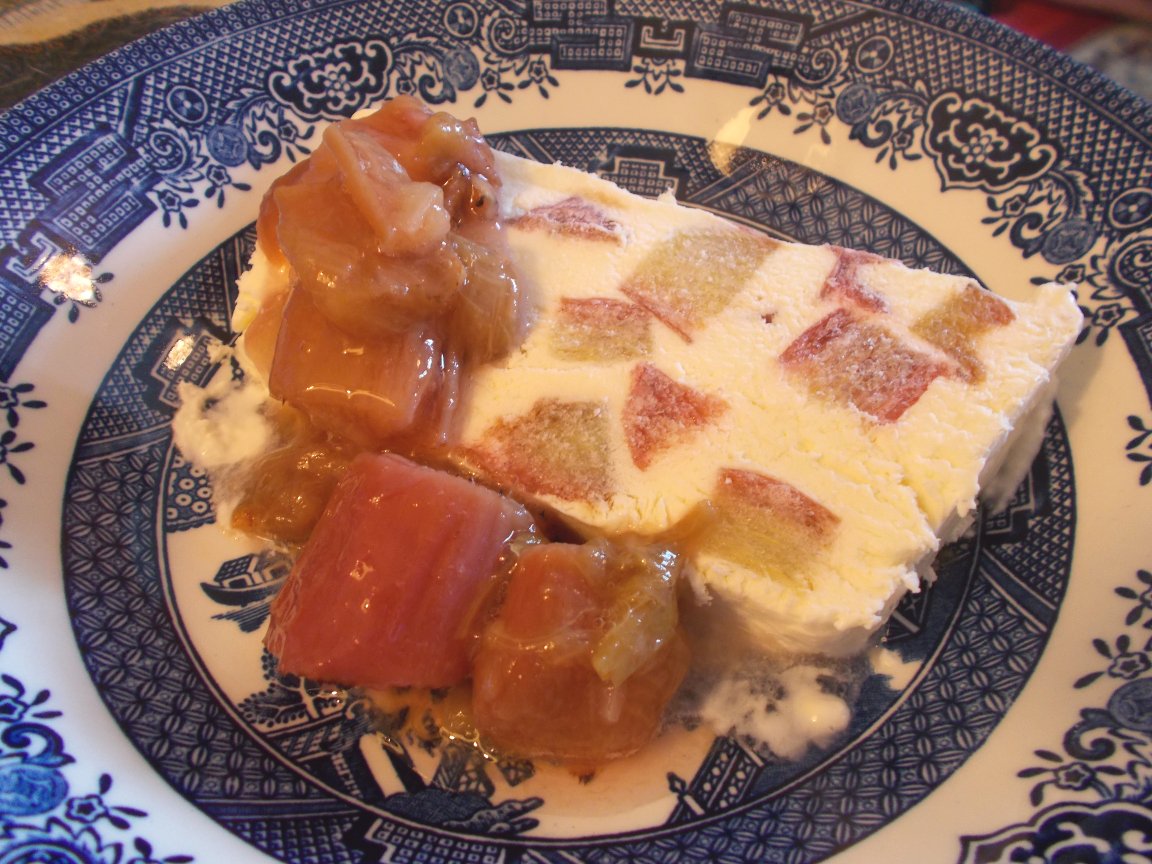
Rhubarb & Mead Semifreddo with compote - such a simple joy!

Okay, now before I go any further, I feel I must explain both Mead and Semifreddo - just in case.

Mead is an alcoholic drink made (in a very skimpy nutshell) by mixing honey with yeast and water and leaving it to ferment.  Hubby has made a couple of batches of this elixir of life and it has very much received the thumbs up from the whole family.  However, if you're not into fermenting or wine making, you can easily substitute a sweet sherry, dessert or Marsala wine which will be slightly different in flavour, but just as delicious.

Hubby's home made Mead
Semifreddo is basically an ice cream.  Both product and name originate in Italy, the home of so many scrummy ice creams.  It translates as "partly frozen" and relates to the fact that the cream mixture is frozen solid, then allowed to thaw for an hour or so prior to serving.  This gives the deliciously icy texture along with the unctuous creamy texture of the thawed edges that is so characteristic of a Semifreddo.

I asked hubby what he would like for dessert on Sunday, following on from our roast pork dinner.  After just a moment's thought, he announced "a rhubarb semifreddo".  Well, what a blindingly good idea!  I briefly considered making it a rhubarb & ginger version but I'm keen to work the Mead into as many dishes as possible, just to prove how versatile it is.

Our first experience of semifreddo was one my Mum made - a mango & nectarine version.  Since then, I have made a lemon version which had a buttery ginger biscuit base and took the cream quantities from this BBC Good Food recipe : Limoncello & Raspberry Semifreddo which sounds equally good.  So this recipe has taken its inspiration from many different sources.

Baked rhubarb, ready for the compote
I was so pleased at how this one turned out, as I really wasn't sure about the quantities of sugar involved.  Well, you know how tart rhubarb can be - but I wanted a degree of that tartness to remain, to provide contrast between the tart fruit and the sweetness of the iced cream.  I decided against a biscuit base, this time, because I wanted to serve the semifreddo with some rhubarb & mead compote and I felt all three would be too much.

All ready for freezing
The end result was truly lovely.  Hubby was fairly incoherent in his attempts to lavish praise upon it, so impressed was he.  He immediately set up a manned exclusion zone around the freezer, just in case anyone attempted to help themselves.  The iced cream was deliciously sweet, rich with the flavours of the Mead and with that slightly acidic tang that creme fraiche brings to the party.  Our home grown rhubarb is so tasty, dear old Ruby and her daughter RubyTwo excel themselves every year in providing the best a rhubarb plant can.

The rhubarb compote, as with the rhubarb for the semifreddo, is made by oven baking the rhubarb, then combining it with the Mead and sugar and leaving the three to match up deliciously.  It was just fabulous along with the semifreddo.  On the one hand, sweet rhubarb with Meady syrup, on the other hand creamy semifreddo with tart fruity rhubarb.  Oh yes.  Very much yes.

The best, the very best, part about this recipe is that it is simplicity itself to make.  No fiddling around with eggs as with so many semifreddo recipes, but a simple matter of two bowls, some spoons and a whisk.  Oh, and a freezer.  Yup, got to have a freezer!

As you'll now no doubt be busting for the recipe, here we go.


RHUBARB & MEAD SEMIFREDDO WITH COMPOTE   (serves 10-12)

Ingredients :

6-8 good sized sticks of washed rhubarb
1, 1 & 2 tbsp granulated sugar
300ml double cream
80g golden caster sugar
400ml creme fraiche
5 & 3 tbsp Mead.

Method :

Firstly, prepare a 2lb-3lb loaf tin (or 2 x 1lb loaf tins) by lining them with a double layer of cling film, which should be significantly bigger than the tin, so as to be able to wrap the contents once frozen.

Then, take 3 or 4 of the pinkest sticks of rhubarb and slice them into half inch chunks, then halve each chunk.  Spread them out onto a non-stick baking tray (non-stick silver foil is great for this!), sprinkle with 1 tbsp of the granulated sugar and place into a pre-heated oven at 180degF/350degC/Gas 4 for 10 minutes, then turn the tray and replace for another 10 minutes until the fruit is cooked through and just beginning to lose juice.

When the cooking time is up, place the rhubarb to one side to cool and prepare the baking tray for another lot of rhubarb.

For this second lot, take the remains of the raw rhubarb and slice into one inch pieces but leave these pieces whole.  Spread them out onto a baking tray and sprinkle with 1 tbsp of sugar, as before.  Once again, exactly as the first time, place into the oven for 10 minutes, then turn the tray and replace for another 10 minutes until the fruit is cooked through, then remove from the oven and leave to cool.

Place the double cream, golden caster sugar and 5 tbsp of Mead into a large bowl and using a hand mixer, whisk until the cream will stand in soft peaks.

Place the creme fraiche into a separate bowl and whisk until visibly softened.  Some will go to soft peak stage, some won't.  So long as the creme fraiche has some air whisked into it, it will do nicely.

So long as the first batch (the smaller chunks) of rhubarb are perfectly cold, add them to the sweetened cream and add the creme fraiche. Gently stir them all together, not being too particular about it.  A certain degree of swirliness keeps the flavours interesting.

Pour the creamy loveliness .. no, actually, before you do anything else, taste the creamy loveliness.  You deserve to know how it is going to taste before the following day when you get to sample the end result .. so, having done that and recovered, pour the contents of the bowl into the loaf tin(s), smoothing down the top layer.

Place - uncovered - into the freezer until the following day, or until solid frozen.  Wrap the overlapping pieces of cling film over the top to protect the semifreddo until you require it.

To complete the compote, take a large Mason Jar or other sealable wide necked container and decant the larger chunks of rhubarb, sugar and any juice that's escaped, into it.  Add the remaining 3 tbsp of Mead and 2 tbsp granulated sugar and mix through lightly.  Seal the top and refrigerate until required.  

To assemble, remove the semifreddo from the freezer around 1 hour before required.  Turn the contents out onto a suitable plate and remove the cling film.  Place into your fridge to defrost slightly.  When ready to serve, using a sharp knife, cut a slice and add a good spoonful of the rhubarb & mead compote.  Enjoy!

Printable version

Related Posts Plugin for WordPress, Blogger...