Showing posts with label food porn. Show all posts

25 August 2016

Persian lamb & vegetable stew - worth every second it is in the oven!

The blame for this recipe lies fairly and squarely with my birthday.  You see, I was lucky enough to be given "The Saffron Tales" by Yasmin Khan, which fired up my already well established liking for and curiosity about Persian - or Iranian - cuisine.  As you'll probably have gathered, I really like lamb and saffron and pomegranate molasses is no stranger to my ingredients cupboard, plus I love using fresh herbs in my cooking, so I was part way there already.

Having lapped up every word of the recipe book, my imagination had been captured.  I wanted to make something for dinner that would encapsulate some of the cooking techniques and flavours I had read about.  Right up there on that list was lamb, which was a fine if somewhat expensive place to start.  However, I discovered that Asda do a bag of frozen diced lamb which gave sufficient quantity for the right price.  I just hoped that the quality would be good enough!  (Which, as it turned out, it was!).

Dried limes at a market in Bahrain c/o Wikipedia
The second essential was that this dish should include Iranian dried limes.  I was SO curious about these little black apparently hollow little ping-pong-ball-alikes.  I really like lime - which helps - and using these odd little creatures was a curiosity all of its own. What would they smell like? (Vaguely liquorice-like).  What do they taste like?  (Aside from the obvious citrus effect, I have never tasted anything quite like them to be able to give you a "tastes like" point of reference).  What effect would they have on a stew?  (A quite incredible and delicious effect, as it happens!).  So they had to be done.

The third essential was that this stew had to use fresh herbs and lots of them.  I'd seen the Gormeh Sabzi, which is a stew made almost exclusively from an assortment of herbs such as parsley, leek, coriander and fenugreek which looked great, but I was a bit nervous about diving straight into a herb stew.  I felt that something a bit more familiar - meat with vegetables and herbs - would be a little less of a challenge to the family.

As a result, I incorporated the best bits of two recipes in order to make this one.  I took the cooking instructions for the lamb from this recipe from House to Home and took the vegetable and herb influences, along with the dried lime cooking advice, from this Ottolenghi recipe.

My only regret was that they both used turmeric instead of saffron, but hey - you can't have it all and turmeric is so good for you!


So it turned into a three stage, three hour process.  Oh boy but it was worth it, though. Each stage is achieved relatively easily and if you do all your chopping and peeling to begin with, that makes the process a whole lot easier.

I was so curious to taste the gravy at the end of the first hour and a half of cooking, as the soft herbs had all gone into the pot for this stage.  Mmmmnn, I could easily have just thickened that gravy and eaten the lamb as it was.  It was tender, the gravy was delicious and the herbs had amalgamated with the spices (turmeric, cumin, chilli) into incredible layers of exotic flavour.  You can only imagine how butter soft the lamb was by the end of three hours!  I had to resist though, as the dried limes had yet to be included.

Now nobody had mentioned how, even though you poke a thousand holes into each dried lime - to let the gravy in and the flavour out - they insist on bobbing about on the top of the casserole's contents and will NOT submit to being submerged.  In the end, I decided to give the contents a stir at 45 minutes, in the hope that they would have softened enough to sink.  They did - so there's a tip for you!


With the addition of the vegetables - and most especially the butternut squash - the gravy began to sweeten somewhat.  (Yes, I did have a taste at the 45 minute mark - well, it was for research purposes as much as anything).  Now the interesting thing is that with the addition of the lime juice (you squeeze each lime against the side of the casserole dish before removing it) which is gloriously flavoured and mahogany coloured, it doesn't wipe out that sweetness.  Yes, there is a citrussy element to the flavour of the dried lime, but it just adds another layer to an already multi-flavour layered concoction, without knocking any particular flavour out of the melange.  Their astringency also has the effect of cutting through the richness of the fatty (no matter how hard you trim it, it's still fatty) lamb.  I am seriously impressed with these dried Iranian limes and can't wait to use them again - perhaps in some rice to accompany a curry.

The final three flourishes - some chopped fresh tomato, currants soaked in lemon juice (I hadn't been able to source any barberries) and the very last minute addition of spinach leaves - were sufficient to just add a freshness to the dish.  So often, casseroles cooked long and slow can become a little muddy-flavoured as they progress.  Not this one - and with the last minute additions, it makes sure of it.


Tasting the stew as it progressed through all the different stages was a real education in flavour development and I encourage you to do the same.  I think by doing so, you will understand how each ingredient is working with the others a lot better than just sampling the end result.

I wasn't brave enough to attempt the traditional Tahdig (golden saffron flavoured rice that forms a crisp crust in the making), I'll leave that for another day.  Instead, I served the stew with simply cooked white basmati rice and a hearty dollop of plain yoghurt.

It really doesn't describe the dish sufficiently to call it a simple "stew", as being English that evokes thoughts of thick gravy and dumplings.  However, I'm hoping that the "Persian" in the name will stop such thoughts in their tracks and send you down more exotic lines of thought!

As my first even half-serious voyage into Persian (Iranian) cuisine, I'm feeling quite satisfied that I did it some justice.  I just hope you will feel the same way.


I have linked up this recipe with the excellent Sneaky Veg Blog
where you can find other interesting recipes.


Hijacked By Twins


PERSIAN LAMB & VEGETABLE STEW   (serves 3-4)

Ingredients :

2 tbsp vegetable oil (I used rapeseed)
500g diced lamb
1 large onion, diced
pinch of sea salt
2 large garlic cloves, chopped
half a tsp ground turmeric
1 tsp cumin seeds
1 tbsp tomato puree
20g fresh coriander, roughly chopped
10g fresh dill, roughly chopped
10g fresh tarragon, roughly chopped
1 litre of lamb stock, made using two stock cubes
1 whole red chilli, pierced all over
4 dried limes, pierced all over
1 large waxy potato, peeled and diced very small
1 small butternut squash, peeled and diced
4-5 mushrooms, quartered
3 vine ripened tomatoes, pips removed and chopped
15g barberries or alternatively currants soaked in lemon juice
a large handful of baby spinach leaves.

Method :

Pre-heat your oven to 140degC/275degF/Gas 1.

Heat the vegetable oil (I used rapeseed) over a high heat in a large frying pan until almost smoky hot.  Add the lamb (gently!) and sear on at least two sides.  Using a slotted spoon remove the lamb to a lidded casserole dish.

Reduce the heat under the frying pan to moderate and add the onion, sea salt, garlic, turmeric and cumin seeds.  Fry until the onion is transparent and just beginning to caramelise but stir often to prevent the turmeric from burning on the bottom of the pan.

Add the tomato puree and stir through.  Cook on for another 3-4 minutes, until the ingredients are well combined.

Gently stir in the lamb stock and add the three fresh herbs.

Decant the mixture into the casserole dish, give everything a stir, whisper some words of encouragement and put the lid on.  Place the casserole dish into the oven and forget about it for the next hour and a half.

Remove the casserole dish from the oven and remove the lid.  Give the contents a stir and have a taste of the cooking liquid, to check for seasoning and to admire how it tastes at this early stage - seriously lovely.

Add the red chilli, the dried limes (which will insist on bobbing around on the surface, because they're so light), potato, butternut squash and mushrooms and stir through.

Replace the lid and put the casserole dish back into the oven for another hour.

At the end of that hour, retrieve the casserole dish and remove the lid.  Stir in the tomatoes and barberries or currants.  Replace, uncovered, in the oven for the remaining half an hour.  (The sauce is fairly thin and of a broth-like consistency, but amazingly flavoured.  If you prefer your sauce thicker, simply stir in a little cornflour mixed with water at this stage, which will thicken the sauce).

Ultimately, once you have finally removed the casserole dish from the oven (and cooked some white rice to go with it), stir in a big handful of baby spinach leaves and serve along with the cooked white rice and a healthy big dollop of plain yoghurt.

Tuck in!

Printable version

18 January 2016

Chicken La Mancha - well this is something different!


I have no compunction in owning up to the fact that the original recipe for this truly wonderful dish, came from my favourite BBC Good Food website, here.  However, don't think that I'm stealing their thunder, because although I did make some slight changes to the recipe, that's not the reason why I'm recording it here.

I'm recording my "adjusted" recipe here because it was so flipping good, I don't want to lose it!  You know what websites are like - they can up and disappear overnight - and I'd hate to lose this one.

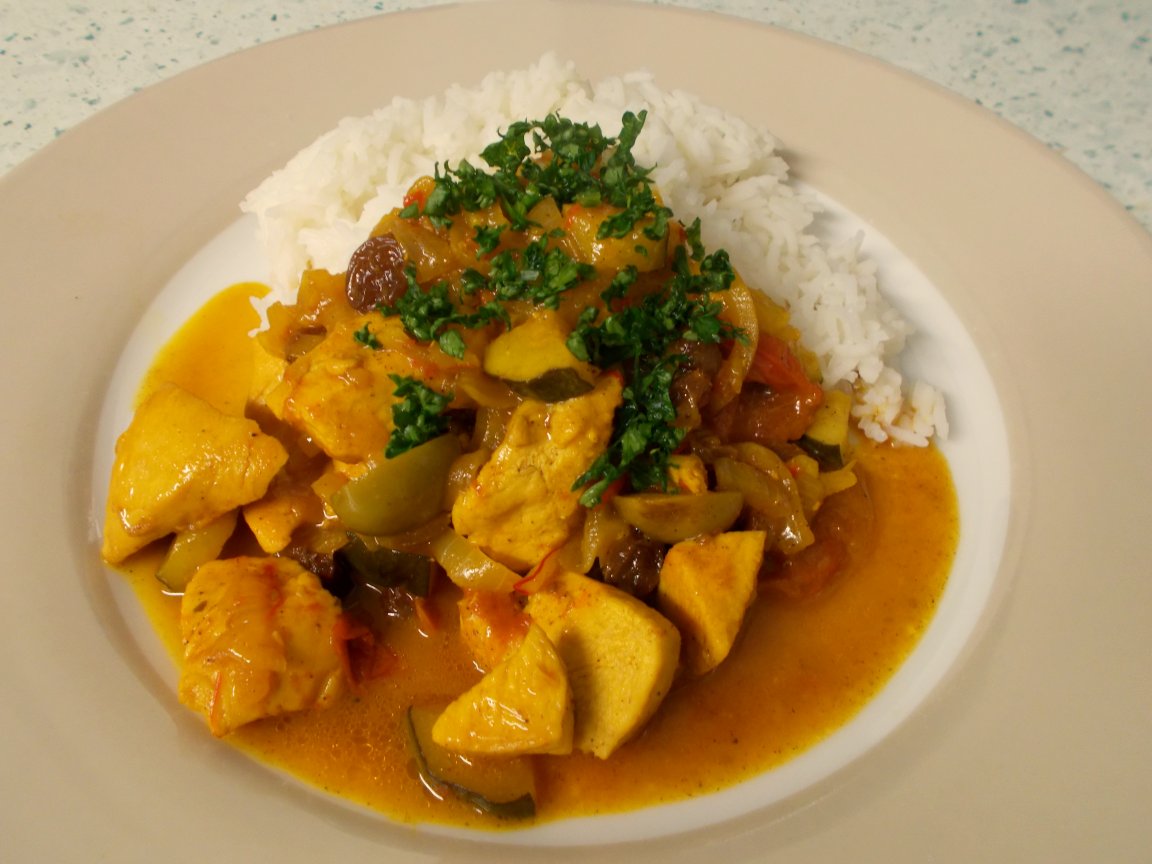
Now this recipe really is something a little bit different.  It is basically a Spanish sweet and sour chicken recipe - but don't think oriental at all.  Instead think saffron, orange juice, chilli and olives.  It also has the benefit of not involving any sweet peppers at all.  Not that I have a problem with sweet peppers, it just makes a pleasant change to not have to put them into something "Spanish".   What makes it "sweet and sour" is the combination of sherry vinegar (my first time using that - and I love it!) and runny honey.  Now I will say, you do need to like saffron for this one.  Happily, I love it - it's by far and away my favourite of all the spices.  If you're going to be picky, then Spanish La Mancha Saffron is the best type to use for this recipe.  However, don't break your neck trying to find some - any old saffron is better than none, but do try to use the saffron threads rather than ground saffron.

The recipe is simplicity itself to both prepare for and make - it's another of my favourite "sit in one place and add ingredients to a pan in the right order" recipes.  I like those.

It is most important that you reduce the sauce down to a syrupy consistency.  It tastes good in the early, wetter, stage - but once you've reduced it down to being syrupy, my goodness but the flavour becomes so intense.  I had a hard job to not taste it too often!

The next time I make it, I may very well include some sliced mushrooms - so you'll see I've included them in the recipe.  The original recipe uses some toasted pine nuts and fresh coriander by way of garnish, however I didn't bother with either of these - I just sprinkled on some chopped parsley.


I served mine with plain white rice, but it could easily have taken some broccoli or green beans as a side dish, or been served with a side salad and some bread to mop up the sauce.

CHICKEN LA MANCHA   (serves 3)

Ingredients :

a large pinch of saffron (Spanish saffron, ideally)
½ chicken stock cube, crumbled into 100ml boiling water
2 tbsp olive oil
1 onion, thinly sliced
1 garlic clove, chopped finely
1 red chilli, chopped and seeds removed if you prefer
2 large chicken breasts, cut into bite-sized pieces
half a tsp of ground cinnamon
150ml orange juice
2 tbsp sherry vinegar
1 tbsp clear honey
10 cherry tomatoes, quartered
1 courgette, quartered and diced
4 chestnut mushrooms, sliced
6 stoned green olives, halved
1 tbsp raisins
1 tbsp finely chopped fresh parsley, for garnish.

Method :

In a small bowl, add the saffron to the hot stock and leave to soak.

Heat the oil in a good sized frying pan and cook the onion, garlic and chilli until the onion is soft and just beginning to turn golden.

Push the onion mixture to one side of the pan and add the chicken. Cook on a fairly high heat for a few minutes until the chicken is browned all over.

Reduce the heat, add the cinnamon and stir through.

Add the saffron stock, orange juice, vinegar, honey, tomatoes, courgettes, olives and raisins. Increase the heat to bring the contents to a boil, then reduce the heat and simmer for ten minutes or until the sauce is reduced and the chicken and vegetables are cooked through.

Serve with a scattering of chopped fresh parsley for garnish.

Printable version

3 January 2016

Diced pork with parsnips & celery in cider (oven version)


Yes, this is a pretty much identical dish to the slow cooker pork shoulder with parsnips & celery in cider - except cooked in the oven.

Sometimes, it's just easier to use a casserole dish in the oven than to break out the mighty weighty slow cooker (or crockpot) - especially when you're going to be indoors and available to keep a wether eye on the oven.  Today was just such a day and as I'd not cooked the pork this way before, I thought I'd indulge.
  
Instead of using the pork shoulder, I cheated unmercifully and bought 500g of diced pork which turned out to be lean and very acceptable indeed.  I shall use that again.


Aside from that, I used a different type of cider - Thatcher's Red Apple Cider.  It did give the dish a worryingly pink hue to begin with, however the colour cooked out as we went along.  The Red Apple Cider is a sweeter version than I would normally have chosen, but it worked very nicely.  I also increased the herbage in the recipe - using sage, thyme and rosemary to just offset the sweetness a tiny bit.  Our smoked salt helped a little there, too.

It sounds a bit like I made a totally different dish, having said all that - but it really isn't.  I served the pork with mashed potato and steamed vegetables (broccoli, carrots, baby corn and Brussels sprouts) and once again, it made a very good Sunday dinner.


Here is the recipe, just in case you too have a non-slow cooker day!

PORK WITH PARSNIPS & CELERY IN CIDER   (serves 3-4)

Ingredients :

2 tbsp olive oil
500g diced lean pork
a pinch of sea salt
a pinch or two of ground black pepper
1 onion, diced finely
2 celery sticks, chopped small
half a tsp dried thyme
half a tsp dried rosemary
half a tsp dried sage
1 large parsnip, peeled and sliced evenly
2 tbsp plain flour
500ml medium or dry cider
200ml stock (I used ham stock, but chicken, pork or veggie would do fine).

Method :

Heat the oil in a deep frying pan until very hot.  Add the pork (cooking in batches if needs be, so as not to overcrowd the pan), season with salt and pepper and fry until golden on at least two sides.  Remove the pork from the pan using a slotted spoon and decant into a casserole dish with a lid.

Replace the remains of the oil onto the heat and reduce the heat to moderate.

Add the onion, celery and herbs and fry until the onion is softened, but without colouring.

Add the parsnip pieces and fry to get some heat into them.

In a small bowl, mix the plain flour with a little of the cider - just enough to create a free running mixture.

Pour the remaining cider into the pan and add the stock.  Increase the heat under the pan and, while the liquid is heating, drizzle in the flour/cider mix.  Stir well to prevent lumps forming.

Continue to stir until the sauce thickens.  Taste for seasoning and adjust if necessary.

Decant into the casserole dish, stir to distribute the pork evenly then cover and place into a pre-heated oven at 180degC/350degF/Gas 4 for 1 hour.

At the end of the hour, give the contents of the casserole a stir and replace into the oven with the lid off.  The casserole can now continue to cook for a minimum of another half an hour, or as long as until the meat is tender and the parsnips cooked through.

Serve with mashed potato and steamed vegetables of your choice.

Printable version

12 September 2015

Herby lamb and pea pie

I love this pie.  Now I know I sound like I love every recipe I make - which I do - but I just love this pie a little bit more.

I've had my issues with pies over the years and yes, granted, this one is just a top-only pie and not a top-and-bottom version so that's easier.  However, it hasn't always been the pastry that has been a problem, but the filling too.

Mostly, to be honest, it has been the gravy or sauce where I've failed.

However, in the Game Pie and with this lovely example here, I got the gravy right.  None of the "gravy like water", where it has been diluted in the cooking.  Equally, none of the "gravy like glue".  No, just a perfectly thick, covering, tasty, unctuous pie gravy that means every forkful will be as delicious as the last and with no resorting to gravy granules.

So I'm pleased.

The pie itself had been simmering on a low heat in my head for a couple of weeks, while I worked out what "interesting" departure from a usual lamb pie I would use.

Mint and Rosemary - home grown, don'cha know!
I was convinced that it would be the juniper berries that I bought for the game pie, right up until - with a stroke of inspiration - I remembered the pomegranate molasses.  Even when I was cooking the filling, I had the juniper berries sat there beside the pomegranate molasses, as I really wasn't sure which one to choose.  Ultimately, I had a little taste of the way the sauce was going, then a little taste of some of the molasses on a teaspoon.  The combination of the two was just so good, I didn't consider the juniper any further.

Lamb often needs something a little bit sweetly acidic to complement its own earthy sweetness and this is why redcurrant jelly does the job so well.  So, if you don't want to invest in a bottle of pomegranate molasses just for this pie (although why not try it drizzled lightly over strawberries and Greek yoghurt - it's otherworldly), add a teaspoon or more of redcurrant jelly instead.  The difference the pomegranate made to the sauce was just incredible, bring it alive in a subtle but definite kind of a way.

Another departure from the norm, is cooking the lamb in pale ale.  So often, you will find lamb cooked in wine - usually red, but I wanted to use something different.  I also wanted to keep to a "country kitchen" kind of a theme, which ale suited so much better than wine.  My plans for the pie didn't suit a very strong, hoppy kind of ale, but a lighter, milder flavour - so a pale ale was fine and the English Pale Ale (from Marstons brewery) that I chose was perfect for the cause.  If you're in a place where Pale Ale doesn't come easily, choose as light a beer as you can find without venturing into lager territory.

Now one other very important thing regarding this pie is that it takes a fair old while from beginning to end, if you want to do it properly.  So it's definitely something that you don't want to attempt when you've only got a couple of hours to spare.

Having said that, however, you can devoted two days to it and cook the filling the day before, so stretching out the effort and making it a little easier to cope with.  Plus, it means you'll be ahead of the game on the day.

Now, as for Cook's Tips, as ever I have a few for you :

Ordinary frozen peas will do if you don't have petit pois.  Nobody's going to quibble over the size of a pea.

You might be surprised that I don't recommend dusting the meat with seasoned flour, rather than adding the flour later.  Well, what I'm avoiding is the burned flour on the base of your pan.  Maybe it's just me, but it so often happens that way - and I didn't want any acrid burned flavours in my softly flavoured lamb.

Now, when you add the ale/flour mixture, if lumps do form (and it often happens), don't panic over it - just break them down into pieces that are as small as possible with the whisk and think no more of it, as they will finally dissolve during the baking.

Even if you've never made pastry before, do give this pastry a go.  It really is so easy to make!  There's no fiddling about with it, no kneading, very little mixing and so long as you add the water in one go to begin with (the 50ml), mix it lightly, add a little more, mix it lightly (just two or three passes of the knife) and keep the water to as little as possible - just enough to keep it together, you can't go wrong.  It really is SO good and suits this pie perfectly.


My last advice to you is to read the recipe a couple of times before you embark upon the bake.  It is always good to have a good idea of what you're doing, before you do it!

I do so hope you enjoy the process of making this pie and that the end result is as successful for you, as mine was.  I shall be crossing my fingers for you!  (Which makes it very difficult to type, but I'll persevere - as it's you). 

HERBY LAMB AND PEA PIE   (serves 4)

Ingredients :

1 tbsp olive oil
450g diced lamb or lamb neck fillet, diced
sea salt
freshly ground black pepper
1 onion, chopped finely
2 garlic cloves, chopped finely
1 medium carrot, diced finely
2 leeks, halved and sliced
500ml pale ale (I used Marston's English Pale Ale)
200ml water
1 heaped tsp tomato puree
1 lamb stock cube (low salt, preferably)
1 tbsp fresh rosemary, chopped
1 tbsp fresh mint, chopped
1 tbsp fresh parsley, chopped
1 tsp pomegranate molasses
2 tbsp plain flour
3 tbsp petit pois.

For the pastry :

150g plain flour
50g Atora vegetable suet
50g salted butter
a pinch of sea salt
50 ml cold water as a minimum.

Method :

In a deep frying pan, heat the olive oil until smoking hot.  Gently add the lamb and spread it out into one layer.  Season with a light pinch of salt and a good pinch of black pepper.  Leave it to cook, only moving it once the pan side has begun to caramelise, then turn it.  Leave until the lamb has browned, then remove the meat to a bowl using a slotted spoon to retain the oils in the pan.


Add the onion, garlic and carrot to the pan and fry until the onion is transparent.  Do not allow it to caramelise or burn.

Add the leeks and reduce the heat slightly.  Return the lamb to the pan and stir through.  Fry the leeks until softened, then decant the pan contents into a casserole dish. 


Add all but 150ml of the pale ale to the pan and bring to a boil.

Reduce the heat to moderate and add the water, tomato puree, lamb stock cube, rosemary, mint, parsley and pomegranate molasses.  Stir through and allow to simmer whilst you mix the remaining ale with the plain flour.


Remove the pan from the heat and add the ale/flour mix.  Whisk through as you are adding, to prevent lumps forming.   Place back onto the heat and stir well as the gravy thickens.

Pour the gravy into the casserole dish and stir through.  Cover the casserole and place into a pre-heated oven at 170degC/325degF/gas3 for 90 minutes.


Once the time is up, remove the casserole from the oven and set aside to cool.

(It is at this stage, if you are making the pie in two instalments, that it would be possible to refrigerate the filling until the following day.  Just remember to bring the filling back up to room temperature before you bake the pie).

Make the pastry for the pie, by placing the plain flour, vegetable suet, salted butter and sea salt into a large bowl.  Rub the butter into the mixture until you have a cross between breadcrumbs and cornflake shapes.

Make sure to stir the pastry with a knife and under no circumstances knead the pastry dough.  Add just enough water to bring the pastry together - just stir a few times with your knife, then pat and push the remainder of the flour into the ball.  Wrap the ball in cling film and leave in a fridge to rest for a minimum of 30 minutes.

Once the meat filling is cool, add the petit pois and decant into the pie dish.


Paint the edge of the pie dish with egg yolk.

Roll out the pastry until it is just slightly larger than the pie dish, then lay it on top of the dish, making sure it meets the edge all the way around.

Press down lightly on the edge, to seal the pastry.  Trim off any excess.

Cut several holes in the centre of the pastry to let out any steam (otherwise the pastry will detach in places) and egg wash with the remainder of the egg yolk.

Place into a pre-heated oven at 180degF/350degC/gas4 for 35 minutes, until the pastry is golden and crisp.

Serve with roasted parsnips, Savoy cabbage and baby corn - or vegetables of your choice.

Printable version

Related Posts Plugin for WordPress, Blogger...