Showing posts with label leeks. Show all posts

12 May 2016

Leek & bacon tart - a quiche-alike!

One of my favourite vegetables is the leek.  Now I know that friends would say there's not a vegetable that I don't like - and I admit they have a point.

However, leeks are right up there in my top 10, along with things like the humble spud and the princely asparagus.

So, when I decided that I must explore egg enriched pastry dough (which is a very lovely thing that finishes with a biscuity texture), I naturally pondered on what to put in said pastry.  Naturally, I contemplated such things as pasties, sausage rolls - even a rhubarb & strawberry pie (which has to be done, very soon).  However, we all like a quiche and even if the pastry was a complete disaster (which it wasn't), I figured you can at least eat the filling out of the middle and save dinner that way.


Having just made a couple of Quiche Lorraines (for different occasions) recently, I was after something more interesting than the standard egg, cheese & bacon.  Consulting my copious list of "recipes gleaned from t'internet", I came across this one - Leek Tart, from the Cooking in Plain Greek blog.  Now, as I've said up there ~nods upwards~ leeks are one of my favourite veggies and I remembered this recipe. I'd had it sitting in my list for probably years, just waiting for a moment such as this.  Curiously, it also uses an egg enriched pastry dough!  Oooh, it was meant to be.


Now because I'm me and you wouldn't expect anything else, now would you?  I tinkered about with the recipe for the filling.  Well, you see, I had 100ml of single cream that had no home to go to and just made sense to put it in this recipe.  I also had more bacon than 100g available to me - and everything is made better with more bacon, right?  I looked up the cost of Gruyere cheese, as I know it has been pricey in the past - and it hadn't improved any.  However, there on the same online shopping page, was Gouda cheese - and for a lot less money.  Well, it seemed to make sense, so that's what I went with.


It even looked fairly pretty before it was baked!
Well, I was jolly pleased with how the whole experiment turned out.  The pastry was light and crisp, with a touch more substance to it, finishing up slightly more biscuity than a standard lard/butter shortcrust pastry.  I shall definitely be using it in more recipes.


The filling became interestingly fluffy from the addition of the yoghurt.  As I mixed it into the eggs, the whole lot thickened - somewhat alarmingly at first - which caused the filling to be a lot less "wet" than a usual quiche filling often is.  Interestingly, our son's opinion of the tart was that the filling was more "wet" than normal, but not in a "runny" kind of a way, but in a juicy-leeks-and-bacon kind of a way.  I know exactly what he means - and I like it!


True, this tart isn't the cheapest to prepare - the butter, eggs, bacon, cheese and cream all add up.  However, it is a deep fill tart and a quarter of an 8 inch tin goes a long way, so you can afford to be cautious with your portion sizes.  I dare say you could easily feed five, if not six, if you're careful with your cutting.

Mmmmmnnnn, there's a good half of my tart left in the fridge.  I can tell, it's not going to have a long wait before it sees me again.

LEEK & BACON TART    (serves 4)

Ingredients :

For the pastry

200g plain flour
100g cold salted butter
1 egg yolk
3 tbsp water
pinch of sea salt
freshly ground black pepper

For the filling

1 tbsp olive oil
100g thickly sliced smoked bacon
3 medium leeks, halved and finely sliced
1 large banana shallot, chopped finely
100ml Greek yoghurt
100ml single cream
2 eggs
freshly ground black pepper
60g Gouda cheese, grated.

Method :

Put the flour, butter and seasoning into your food processor and process until the contents resemble fine breadcrumbs.  Add the egg yolk and the water and blitz again, until the contents form a clump.

Decant out onto a large piece of cling film and form into a ball and cover with another big piece of cling film.  Then, roll the pastry out flat until sufficiently large to line your 8 inch pie dish, or tin.

Remove the top layer of cling film and drop the pastry into the dish, pastry side down.  Ease the pastry into the dish with the cling film attached and once securely lining your dish, remove the cling film.  Trim the pastry to fit and crimp the edges in a pretty pattern.

Pre-heat the oven to 180degC/350degF/Gas 4.

Cut a piece of baking parchment to slightly bigger than your pastry lined dish, then crumple it into a ball and smooth out on top of the pastry.  You'll find crumpling it like this allows it to fit the dish better.  Tip in a good quantity of baking beans (to prevent the pastry from bubbling) and place the pastry case into the oven to part bake for 15 minutes.  Once the time is up, remove from the oven, remove the parchment paper and baking beans and set the pastry case aside to cool slightly while you prepare the filling.

Heat the olive oil in a frying pan and add the bacon.  Fry over a high heat until all the water has evaporated and the bacon is just beginning to turn golden.  Reduce the heat to moderate and add the leeks, shallots and more black pepper.  You may need to add a little more olive oil at this stage - I use a little extra virgin olive oil for flavour.  Once the leeks are softened, remove from the heat and set aside to cool slightly.

Place the yoghurt, cream, eggs and black pepper into a bowl and whisk to combine.

Add a small amount of the grated cheese to the bowl, along with the leek mixture from the frying pan.  Stir quickly and gently, to combine.  Then, pour the filling into the pastry case, taking care to distribute the leeks and bacon evenly.

Sprinkle the remaining cheese over the surface of the leeks and put the whole thing into the oven (middle shelf) for some 35-40 minutes, or until the surface is nicely golden and the centre feels firm and not at all squishy.

Set aside for 10 minutes or so to settle before serving, or alternatively allow to cool and serve at room temperature with salad.

Printable version

7 November 2014

Greek style gorgeousness - Chickaleekaka!

Well, what a thing of great beauty this recipe turned out to be!  I found it on Petit Chef, in a vegetarian version without the chicken (and other bits), here.  I really liked the combination of flavours and was intrigued by the use of the white wine.  However it didn't have enough "oomph" for my menfolk as a main course, yet seemed too heavy for a side dish.  So after a bit of mental juggling with a few protein sources such as ham (which I'm sure would be great, but good ham is hard to find for an affordable price), salmon, smoked haddock or sausage - I decided to continue the theme of delicate flavours and go with chicken.  After all, chicken and wine, chicken and leek, chicken and cheese, all go well together and it certainly isn't going to argue with eggs!

Just baked - and you can see the importance of the cheesy crust.
Yes, it takes a little bit of fiddling around as it's a three-stage dish where cooking and assembly is concerned, but if you start early and leave yourself a bit of time in which to give the ingredients the respect they deserve, it really isn't difficult at all.  I served mine with a tomato, spinach & red kidney bean salad (primarily for me!) and a few garlic butter doughballs (as a bit more carbohydrate for the menfolk).

Evaporating the wine.
This family all have a marked soft spot for a Greek recipe - there's something about the ingredients and the style of cooking that just hits the spot with us.  It must be the rich/healthy combination of a baked dish paired with a side salad, using indulgent ingredients like cheese and eggs, plus juicy tomatoes and healthy spinach.  Put it this way, not one person had an ounce of anything left on their plate, so it must have been good!

I was very interested to see how the wine infused itself into the chicken and suffused the leeks with a subtle but very much "there" flavour of sunshine and fruit which added the necessary acidity to cut through the richness of the Bechamel and cheese.  I added a small amount of thyme for an additional layer of flavour, which worked beautifully and didn't swamp the dill at all.

The additional mustard in the Bechamel was a great idea too, as it gave the mild, creamy sauce just that tiny edge which stopped it from becoming too much.


I can hear you wondering what cook's tips I might have for you about this one.  Well, as it happens, I do have a few!

Now you might wonder why I used skimmed milk, but added double cream.  Well, I wanted a richness through the sauce but not too much and considered that using semi-skimmed milk would mean I had to reduce the amount of cream I used.  Using the skimmed gave a perfect balance between milk and cream that didn't make the sauce too heavy.

However, the biggest tip I have for you is to make the Chickaleekaka (which, by the way, is a combination of "chicken", "leek" and "Moussaka-like-thing") in a dish which you've lined with non-stick silver foil, so that once cooked, you can lift it out of the dish and onto a chopping board.  From there, you can gently peel down the edges of the silver foil and the Chickaleekaka should stay, in one set piece, without collapse.  (The eggs are fundamental in this as they are what cause the lower layer to set).  You can then cut it into neat portions which helps to make it look that little bit more deliciously intriguing - and you don't lose those lovely crusty edges by leaving them in the dish!


A quick word about what size dish you choose might be in order, too.  You need to make the Chickaleekaka in a dish that is deep enough to give you a good 1-2cm of chicken & leek, with a nice deep layer of Bechamel on top.  Use too big a dish and it will be spread too sparsely.  Far better to go small - but deep - than too big and shallow.

My tomato/spinach/kidney bean/cress "hot plate" salad.
As for what would you serve alongside the Chickaleekaka, well I went for a "hot plate" salad, i.e. a salad that could be served on a hot plate.  This consists of items that can stand up to heat - so tomato, baby spinach, red kidney beans and cress were my choice on this occasion, but the possibilities are endless.  Just steer clear of things that wilt quickly like iceberg lettuce, if you're going to be serving it on a hot plate!

I know I'm going to be making this again very soon - and I'd really love to hear what you think of it, if you give it a go too.  So do leave me a message, if you try it!

CHICKALEEKAKA    (serves 4) 

Ingredients :

1-2 tbsp olive oil
2 skinless, boneless chicken breasts, sliced small
500g leeks, sliced small
half a tsp white pepper
a tiny pinch of sea salt
half a tsp of dried thyme
100ml (or thereabouts) dry white wine
20g fresh dill, finely chopped
3 large eggs
250g mature cheddar cheese, grated.

For the Bechamel :
3 tbsp of salted butter
4 tbsp of plain flour
a generous pinch of white pepper
a tiny pinch of sea salt 
350ml of skimmed milk
2 tbsp double cream
half a tsp Dijon mustard
half a tsp of fresh grated nutmeg
20g parmesan cheese, grated
50g mature cheddar cheese, grated.

Method :

1.  Heat the olive oil in a frying pan and once hot, add the chicken.  Spread the chicken across the pan to cook evenly, as it won't take long, being such small pieces.  Toss the chicken a few times to make sure every side is coloured - but don't allow it to turn golden.

2.  Once the chicken is coloured but not cooked through, add the leeks and seasoning.  Continue to fry until the leeks are softened.  You will need to toss and stir regularly to prevent the pan contents from colouring further.

3.  Add the wine and continue to toss and stir until the wine has all but evaporated and the pan is almost dry.

4.  Decant the chicken & leeks into a large pyrex bowl  and set aside to cool for 5 minutes or so.

5.  Once cooled, add the dill, crack the eggs in and add the grated cheese.  Mix and stir until everything is evenly distributed.  Set aside, while you make the Bechamel sauce.

6.  In a medium pan, set the butter to melt and add the flour, salt and pepper.  Allow the flour to cook out gently for 3 or 4 minutes, but don't allow it to brown.

7.  Add a little of the milk and stir it through.  The mix will set up quickly, so take if off the heat and keep adding a little milk, then stirring - you will probably need to swap to a hand whisk - until you have a saucy textured mix which is somewhat wetter than you would require.  Add the cream, mustard and nutmeg and whisk them through, then put the pan back on the heat and keep stirring or whisking as it heats through to simmering point.  If the mix becomes too thick, add a little more milk - but not too much, or it will quickly become too thin.  You're after a consistency reminiscent of thick custard.

8.  Take your baking dish (I used a small roasting dish that I lined with non stick silver foil) and decant the chicken & leek mixture into it, making sure to push it into the corners and level off the top surface.

9.  Pour the Bechamel over the top and again, encourage it to form a smooth layer.

10.  Sprinkle first the parmesan, then the cheddar, over the top so that the surface is entirely coated.  This will form the gorgeous cheesy crust - too little cheese and the crust will be patchy at best.

11.  Place into a pre-heated oven at 180degC/350degF/Gas4 for 30-35 minutes or until the top is a gorgeous golden brown.

12.  Remove from the oven and allow to settle for 5-10 minutes before serving with a side salad.


13 October 2014

Homity Pie - well, the low calorie version!

There has been a lot of interest shown on the Rhubarb & Ginger Facebook page, in the Homity Pie that I found on the Slimming World website and which I have now cooked twice.  So, I thought I'd open it up to a wider audience and blog the recipe.

Now, first thing I will say about this recipe is that the true Homity Pie is contained in a pastry case and is a vaguely Quiche-like "pie".  However, because this is the low calorie version, we've jettisoned the pastry case.  Don't let that stop you from putting the pie filling into a pastry case if you're not watching your weight, or want to present it to an audience other than the family.  I would recommend a shortcrust or filo pastry crust, as it could all get a bit heavy with puff or flaky.

So, what actually is "Homity Pie"?  Well, it has an interesting history - going back to wartime rationing, land girls and making use of what you've got available.  It is basically, mashed potato with added flavourings such as onion, leek, cheese, garlic, peas - whatever you've got by way of veggies, with eggs to provide a little rise and lightness.  So simple, but it works so well!

Both times I cooked it, I used it as an accompaniment to a roast chicken.  Well, sometimes you fancy something other than roast potatoes.  Not often, I grant you, but when you do - Homity Pie does the trick.  I could imagine it would go very well with whatever you want to add it to - sausages, chops, steak, braised beef, gammon - I can't think of anything that it would be out of place beside.  Well, discounting things like curry and apple crumble, of course!

The leftovers have been useful to accompany things like bacon, a fried egg, cold meats and pickles for lunch, too.  A quick turn or two in a dry frying pan to heat it up and draw off some of the moisture that inevitably accumulates and it is good to go.

Once again, another wartime recipe proves its worth in these times of austerity.  As with the rice pudding I recently posted, I do love a flexible recipe!  The ingredients of a Homity Pie are about as flexible as can be, the only essentials being the mashed potato, cheese and eggs.  After that, you can add whatever the heck you like by way of vegetables - however, I would recommend that any hard veggies like carrots are pretty much cooked before they go in.  Having your teeth bounce off a piece of uncooked carrot could easily ruin what was otherwise a great dish.


Cooks notes :  the original recipe (see Slimming World link above) is a really low calorie version, if you're interested in taking the recipe that far.  I have added mushrooms to my version of the recipe, which doesn't add much to the calories, but does add heaps to the flavour.  I have also used a full fat mature cheddar, as half fat cheese just isn't worth calling cheese, in my opinion.  I've also used olive oil instead of the recommended low fat cooking spray, as I'd rather know what I'm using - and anyway, olive oil is good for you!

So, the next time you're pondering on what carbohydrate to put with a meat, whip up a Homity Pie.  Your family will thank you for it.


HOMITY PIE  (Low calorie version)   (serves 4-5)

Ingredients :

400g potatoes, peeled and cubed
100ml milk
knob butter plus 10g butter
sea salt
freshly ground black pepper
2 tsp olive oil
225g onions, chopped
225g leeks, thinly sliced
2 garlic cloves, finely chopped
3 large chestnut mushrooms, halved and sliced
198g frozen peas
a handful of fresh parsley, chopped
half a tsp dried oregano
2 eggs, lightly beaten
85ml of vegetable stock
160g mature Cheddar cheese, grated
Salt and freshly ground black pepper.

Method :

1.  Preheat your oven to 220degC/425degF/Gas 7.

2.  Boil some salted water in a large saucepan and add the potatoes.  Cook on a medium heat for 15-20 minutes, or until tender. Drain, return to the pan and mash with 100ml of milk, a good sized knob of butter and some seasoning, but a good deal of pepper. Set aside to cool until needed.

3.  Add the olive oil to a frying pan and cook the onions on a medium high heat with a pinch of salt to draw out the moisture, until softened and transparent.  Add the garlic, leeks and mushrooms and reduce the heat slightly once they have started to soften.  Add the peas to defrost and finally add the stock to deglaze the pan.  Set this aside to cool slightly.

4.  Grate the cheese then add half to the mashed potatoes, along with the parsley, oregano and eggs.  Give a quick stir to combine, then add the vegetables and stock.  Stir through quickly, so as not to allow the egg to set. Spoon the mixture into your ovenproof dish and scatter over the remaining cheese.


5. Bake for 30-45 minutes or until risen slightly and golden in colour.

Calories per serving : 275 (reference : Calorie Counter)

Printable version

21 February 2014

Watercress and Leek Soup - fantastic green gorgeousness

Just look at the colour of that soup!
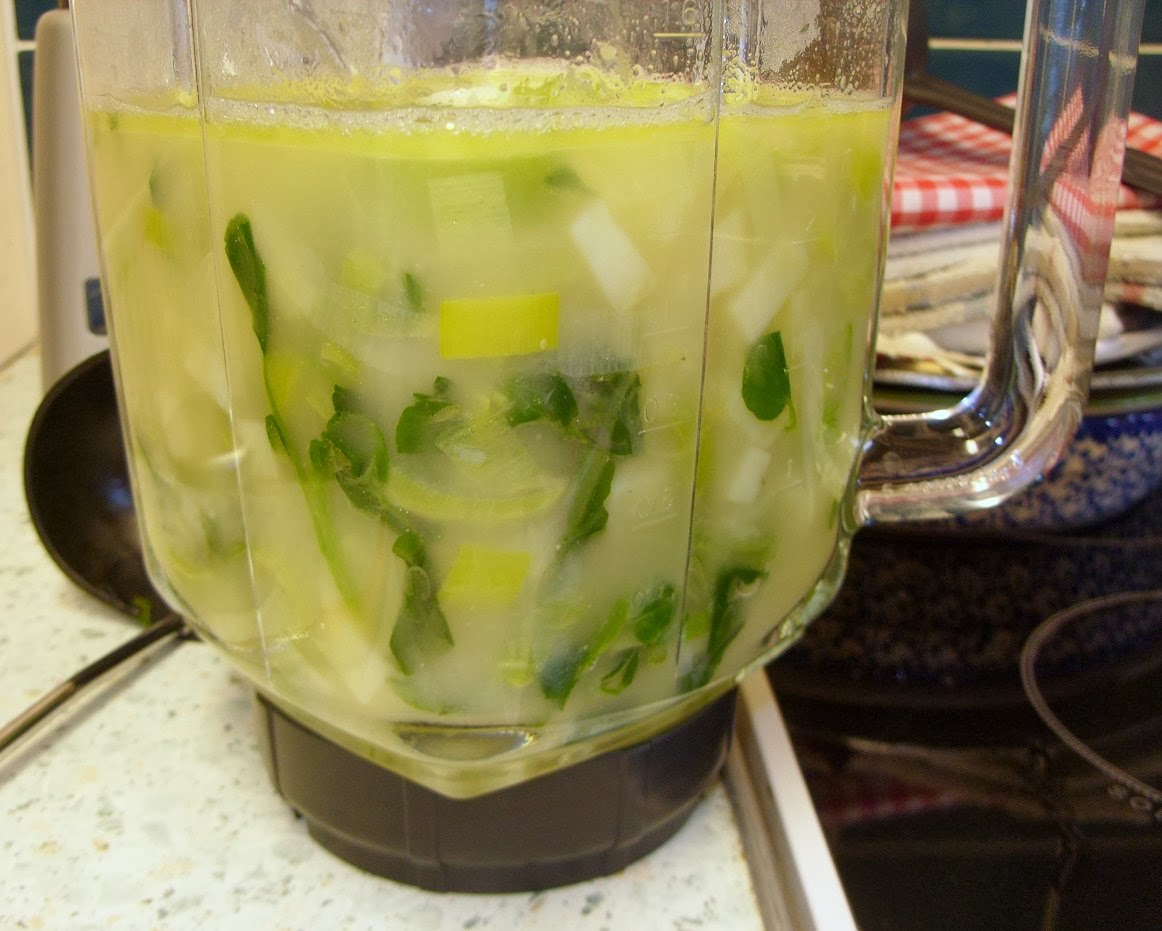
At the bottom of the Le Blender review, I said that I would detail the recipes used if anyone was interested.  Well, there seems to be a fair amount of interest in the Watercress & Leek soup, so here we are - one recipe.

Now I will hasten to add that I borrowed one of Saint Delia Smith's recipes for the soup, however as is always my way, I tweaked it about a little.  It would seem that you folk out there trust my tweaks and want to have the tweaked version - which makes me very humble.  Saint Delia, I apologise for usurping your recipe!
 
It looks so good for you, with such beautiful colours

Because I was testing Le Blender for the review, I was naturally particularly interested in a soup which required blending - and so I wanted something that I knew would resist the blender a little.  Now I have made watercress soup in the past and had terrible trouble getting it smooth - but only because I had a weedy blender.  However, do bear in mind that if you have an especially low powered blender, you won't be able to get the soup to a completely smooth texture.  It won't change the flavour, but just be aware so that you're not all disappointed that you can't get it as smooth as you might like it to be.
 
You see how it loses some of the vibrancy of colour in being cooked

Making the soup is easy peasy double squeezy, as they say.  It is easily tweaked to your own palate's preference, if you like more watercress to leek, then up the quantity of watercress and drop the quantity of leek.  Equally, if you prefer the leek to the watercress, reverse that process!  The one big difference between the two recipes is that I opted to retain some of the watercress and include it uncooked.  This not only brightens the colour of the soup, but also helps the watercress flavour along and is very well worth doing.
Ready for the raw watercress and then to be blended

Now, one thing that is also worth mentioning, is about the butter.  Owing to my having developed a sensitivity to cow's milk, I have taken to using goat's butter - which is just gorgeous.  Yes, it does carry that slight "goaty" flavour that a creamy goat's cheese has - but in this soup goat's butter is a match made in heaven and better for your digestion too.  By all means use cow's butter, but if you like goat's cheese, I'd give it a go.

Mmmn.  Smooth as silk and tasty as they come!
My last cook's tip, is about the quantity.  The following quantity makes either enough for three people for a main course, or sufficient for four or five for a starter.  The soup would make a fantastic starter, being that lovely combination of creamy and light.

So let's stop blathering about it and get on and make it!

WATERCRESS AND LEEK SOUP   (feeds 3 for a main course or 4-5 for a starter)

Ingredients :

150g watercress
75g butter
2-3 leeks, washed and chopped
3 medium potatoes, peeled and diced finely
1 litre approx of a good vegetable stock
half a tsp of white pepper
half a tsp of freshly ground black pepper (or to taste)
a pinch of sea salt
2 dessertspoonfuls of creme fraiche.

Method :

1.  Separate out two big handfuls of watercress and retain in a bowl.

2.  Heat the butter in the bottom of a deep saucepan with a lid.  Once melted, add the remainder of the watercress, the chopped leek and diced potato.  Stir everything until it is covered with the melted butter, then add a tablespoonful or two of water and cover with the lid.

3.  Allow the vegetables to sweat over a low heat until softened, stirring occasionally to make sure that the potato doesn't stick to the bottom of the pan, for around 15-20 mins.

4.  Add the stock and white pepper and stir well.  Bring up to simmering point and allow to simmer until the potato is tender and will fall off the point of a knife.

5.  Remove from the heat and add the retained watercress.  Allow the soup to cool slightly and the watercress to wilt, before blending to your preferred texture.  Season to taste with a little extra sea salt and some of the black pepper.

6.  Return to the pan and reheat gently - do not allow the soup to boil - while you add the creme fraiche.  Stir through until it has dissolved into the soup.

7.  Serve in warmed bowls, with a little black pepper and some watercress leaves (there are always some left clinging to the bowl) as garnish.

Luscious!

Printable version
 

4 August 2013

Cheesey Seafood Gratin - fish is delicious on a budget!

Now, don't go looking at the title of "Cheesey Seafood Gratin" and immediately think "oh, I can't afford that".  I know that there are people out there for whom the price of this dish would be prohibitive, lord knows I've been one of them, but it really is about the cheapest way short of having a friendly fishmonger nearby or going out and catching your fish.

Most supermarkets, these days, are selling what they call "Fish Pie Mix" in their frozen food section.

These fish pie mixes contain a selection of fish - mine had smoked haddock, salmon and cod - and are obviously there to catch all the little bits of fish that are offcuts from making bigger chilled dishes.  They also provide an outlet for all those tiny fish that are caught along the way.  You only have to look at a cross section of one of the fish pieces to realise that it had to have come from a teensy fish.  Well that's fine, because at the price they're offered - mine was £3 for 300g - they aren't exactly cheap, but then they're not exactly THAT expensive either.  Now, across 3 people, 300g of fish isn't that much, so I added one of Asda's "cheap as chips" 200g bags of coldwater prawns - which at £1.50 made the price of the fish up to £4.50.

Once upon a time, I'd have been looking to spend no more than £3 on meat or fish for a meal - but no longer.  The upper limit has had to be moved to no more than £5 these days, so this just fitted.  The only thing you have to remember, when using frozen fish of any kind, is to squeeze it gently between some kitchen paper before adding it to your dish - otherwise you'll find it releases a ridiculous amount of water and turns your lovely sauce to soup.

I found this particular recipe in the BBC Good Food magazine for September and don't seem to be able to find it anywhere else online at the moment, otherwise I'd send you there.  So, just for the moment, this is about the only place you'll find this particular recipe!

Just out of the grill and as hot as the surface of the sun!

I was immediately attracted to the photograph - I'm a total sucker for anything remotely gratinated.  Show me a cheese sauce, white sauce, seafood sauce - you name it, if it's with a roux style sauce, I'm interested.  The combination of cheese and fish was attractive too, not least because so many of the t.v. chefs who cook Italian style food are adamant that cheese and fish should not appear on the same plate.  Oh, I'm just a little rebel at heart, you see.  What?  That's news to you?  Just ask my Mum, she'll tell you.
 

What you can't see in these photographs, though, is that hiding under the fish and prawns (which I do accept, you can't see those either) is a layer of sauteed leek.  Now for me, that little layer of soft green leek really made this dish.  Without it, the texture would have been too squishy.  However, with the addition of the leek, they gave the texture a lovely soft crunch that, along with the wholegrain mustard, brought the dish together beautifully.

As for the mechanics of making the dish, well it couldn't have been easier.  I opted to make my own cheese sauce because I find making a roux based sauce extremely easy, but if you were in the market for a quick meal or have physical challenges in the kitchen, just buy a pot of cheese sauce.  Yes, it adds to the price - but it will speed things up.  I simply made the sauce, sauteed the leeks, assembled the dishes (I made it in three individual dishes as you can see from the photographs) and while it was in the oven, put together the simple salad and buttered some bread.  I even had time to do the small amount of washing up that had accumulated.

A word must be had about the type of cheese you use.  I used an extra mature cheddar because I like the way it behaves in a cheese sauce and we like our cheese sauces to be really, really cheesey.  However, there is a slight problem with extra mature cheddar in that it really doesn't like being grilled.  Doesn't like it at all.  So when it came to grilling the tops to provide a nice baked crust, as you can see, it didn't really work.  What I should have done, was buy a less mature cheese to use in grating over the top - but for the sake of a few moments grilling, it seemed an unnecessary expense.  However, if you aren't so bothered about a REALLY cheesey sauce and like the baked top, opt for a medium cheddar and that should work better for you.

The mustard is a must-have in this dish.  Without it, the sauce wouldn't have that piquancy that stops it from becoming sickly.  I dare say it doesn't have to be wholegrain mustard - I should think that a good slug of English would do nicely and at a pinch maybe Dijon, but I'd be careful about the Dijon making the sauce a little bit too piquant.


The original recipe required 10g of fresh parsley to be chopped and half added to the sauce and half reserved to sprinkle over at the end.  I, stupidly, had forgotten to order the parsley so we did without.  I didn't miss it, although it would have made the end photograph a bit prettier!  So, it's up to you whether you include it or not.

I should also think that this is one of those dishes that could transcend the seasons.  In the spring and summer, serve it with salad - and in the autumn/winter it would be lovely with mashed potato, carrots and peas.  You could also jazz it up with lovely things like lobster (yes, I know, I'm laughing at the very idea too) and scallops (sometimes you can find some affordable scallops, depending on the time of year).

In short, this is a really flexible but truly delicious meal that everyone here enjoyed.  Son & heir liked it so much he even bothered to stop long enough to wipe his dish clean with a crust of bread.  Now that's a seal of approval, if ever there was one.

CHEESEY SEAFOOD GRATIN   (serves 3)

Ingredients :

50g unsalted butter
3 dessertspoonfuls of plain flour
sea salt & freshly ground black pepper
1 pint of whole milk
2 tsp wholegrain mustard
200g cheddar cheese, with some held back for sprinkling
2 tsp rapeseed oil (or olive oil)
2 large leeks, cleaned, halved and thinly sliced
300g frozen fish pie mix, defrosted
200g frozen prawns, defrosted
salad and wholemeal bread slices, to serve.

Method :

1.  Pre-heat your oven to 200degC/400degF/Gas 6.

2.  Skip this bit if you've bought yourself a pot of cheese sauce - except to add the mustard to the sauce, then go to stage 4.

If you haven't bought cheese sauce, take a small saucepan and melt the butter in it.  Once melted, add the flour and stir to combine.  Let it cook for a few moments, but without turning brown.  Add a teensy tiny pinch of salt (there's loads of salt in the cheese and the fish, so go carefully) and a good twist or four of black pepper.

3.  Reduce the heat and add the milk in instalments, stirring like a mad thing in between instalments so as to remove the lumps.  However, don't stir too madly or you'll be washing floury milk off your walls.  Once you've added approximately half the milk and the lumps are (hopefully) all gone, increase the heat and stir until the sauce thickens.  I was left with just a touch of milk in the bottom of the pint container, but it all depends on how much flour you put in as to how much milk you will need to achieve the right consistency.  You're looking for a really quite thick sauce, as the addition of the cheese will let it down a little.  So, remove the sauce from the heat and add the mustard and cheese.  Stir to combine them through the sauce while the cheese melts.  Once it has all melted, set it aside while you take care of the leeks.

4.  If you're clever at multi tasking, you could do this stage at the same time as the sauce.  I can't - I'm rubbish at multi tasking and generally only have one hand to stir with as the other is holding myself up.  Ooh, arthritis is such fun!

So, gently heat the rapeseed or olive oil in a frying pan and add the leeks.  Cook them slowly, stirring often to prevent any from going brown, until they are softened but still have a soft crunch to them.  Remove from the heat and begin to assemble the dish.

5.  Decide whether you are going to make this in one big dish, or in individual dishes.  I'll assume that you've gone with the individual dishes route, for the sake of this recipe.

6.  Take the leeks and divide them equally between the dishes.

7.  Take the fish pie mix and drain off the water.  Drop the pieces of fish onto several pieces of kitchen paper and lay another couple of sheets on top.  Squeeze gently, to remove the bulk of the water from the fish.  Then divide the fish equally between the dishes.

8.  Do the same process for the prawns - drain, kitchen paper, squeeze, divide equally.

9.  Take the cheese sauce and again, divide it equally between the dishes, making sure all the contents are covered and the top is levelled.

10.  Sprinkle with the remaining grated cheese and place the dishes into the oven for 15 minutes.

11.  To achieve the baked cheese effect on the surface of each dish, place under a hot grill for a few minutes, or even give them a blast with a blowtorch.  However, take note of the fact that an extra strong cheddar just won't bake in the way that a medium cheddar will.

12.  While the dishes were in the oven, assemble some salad ingredients on each plate and butter some wholemeal bread.  Once the dishes are done, add one to each plate and serve amidst dire warnings as to the temperature of the gratin, which is something akin to the surface of the sun at this stage.  Blow a lot on the first few forkfuls!

Printable version

21 November 2012

Goat's cheese, leek & hazelnut super-smart tart!

Now there are some tarts that are nice but dull - and some tarts that are surprisingly delicious.  This is one of the latter.

I liked the idea of this tart for more than one reason.

First of all, I really like leeks - they're the only one of the onion family that I can eat without experiencing some severe regret in the tummy department, later on.  I particularly like the way they are so adaptable and can be used in so many different ways.  My favourite leek recipe is the Tave Me Presh or Baked Mince with Leeks.  If you haven't tried this recipe yet, do give it a go.  Trust me, it's fabulous.

Goat's cheese always gets a thumbs up from me.  There was a time when I found goat's cheese to be entirely too "goaty" for comfort.  It always tasted wonderful, but I just couldn't get past the smell.  It always brought back memories of Harvey - a goat-I-once-knew - and his stinky beard.  ~shudder~  Why boy goats think it's sexy to pee on their own faces (which could be defined as a talent, I suppose), God only knows.

These days, I seem to have been able to get past the Eau de Harvey and into the lovely creamy texture and fresh flavour of goat's cheese.  So I could imagine how the creamy goat's cheese would go so well with buttery leeks.

The tips of the goat's cheese caught a tiny bit - but it certainly didn't mar the flavour!

Now the addition of hazelnuts to the equation is a new one - and jolly interesting, I thought.  I have to be careful over the use of nuts in my cooking, as hubby has some tooth issues and we don't want him to lose one of them on a surprise nut.  The problem was easily dealt with, as the nuts are sprinkled on top of the tart filling as opposed to being mixed in.  I simply sprinkled hazelnuts over three quarters of the tart - and sprinkled a little red chilli on hubby's portion.  Where there's a will, there's a way!

It may seem ridiculous to be concerning one's self over the fat involved in pastry, when the filling of the tart includes full fat creme fraiche and full fat goat's cheese.  However, as the old lady said as she wee'd in the sea - every little helps.  Because this tart uses filo pastry sheets to build up its pie crust, you can at least consider that a certain amount of fat has been reduced.  Aha, yes, I hear you thinking "but, surely you need to brush the filo pastry with melted butter?".  No - you don't.  I know, it goes against all previously received wisdom, but you just lay the pastry sheets down - and fill them up with filling, then bake.  Don't ask me why or how, but it works.

I gave the egg mixture a jolly good whisking before pouring into the pastry and I think it was worth doing so, as the filling rose beautifully.  It was light and fluffy - almost souffle-like, although I hadn't taken the eggs that far.  All in all, it made for a lovely light, fluffy forkful of deliciousness.

I served the tart with a simple salad made with a watercress/lambs lettuce/rocket combination of salad leaves and a diced avocado.  Just think of all the lovely nutrients we gained from that combination.  I always feel healthier just thinking about eating watercress and avocado, never mind actually doing it!

I also made some mini Paprika Roast Potatoes, which went extremely well with the whole combination.  They aren't so bad as you might think, either, as you simply dice the potato then toss it in a tablespoonful of rapeseed oil (which has health benefits all on its own), a pinch of salt and pepper and 1 tsp of sweet smoked paprika.  Roast in a hot oven (I put them on the rack above the tart, which was cooking at 180degF) for some 45 minutes, remembering to give them a toss around half way through and you're done.

Obviously, hubby knew that the tart was vegetarian - but I seriously doubt that son & heir even gave it a moment's thought that he had no meat on his plate.  Now that's the kind of meat-free meal that makes you want to serve another! 

With the salad and the roast paprika potatoes, it made for a satisfying meal


GOAT'S CHEESE, LEEK & HAZELNUT TART   (feeds 3-5)

Ingredients :

4 large filo pastry sheets, halved
a knob of butter
1 leek, trimmed, quartered lengthways and sliced finely
1 tsp Dijon mustard
250g creme fraiche d'isigny (or low fat creme fraiche if you must)
2 medium eggs
140g soft goat's cheese
sea salt & freshly ground black pepper
25g toasted hazelnuts, chopped.

Method :

1.  Pre-heat your oven to 180degC/350degF/Gas 4.

2.  Taking one half sheet of filo pastry at a time, lay it into the bottom of a 23cm quiche dish or loose bottomed tart tin.  Without brushing with oil, lay the next one at an angle to the first - and so on - until the sheets have covered the tin and formed a base for the tart, with no gaps for leaks and with the edges draped over the sides of the tin.

3.  Heat the knob of butter in a frying pan and once melted, add the leek pieces.  Cook on a gentle heat until softened but not browned at all.  Set aside to cool slightly.

4.  In a large bowl, whisk together the mustard, creme fraiche, eggs and a third of the goat's cheese.

5.  Add the leeks and stir through, including some seasoning.

6.  Pour the egg mixture into the flan case and add pieces of the remainder of the goat's cheese, distributing them evenly.

7.  Sprinkle over the hazelnuts and fold in the overhanging pieces of filo pastry.  Brush these with a little oil.

8.  Bake the tart for some 25-30 minutes, until the filling is risen and golden, with just a little jiggle left in the centre.

9.  Allow to cool in the tin for some 10 minutes or so, then remove and cool until just warm.

Serve with some mini paprika roast potatoes and a salad of watercress, rocket & spinach with avocado.

Printable version

20 September 2012

3 Cheese & Leek Tart - it's all down to taste!


It’s a funny thing, taste.  No, not “taste”, as in flavour – but “taste” as in “preference”.

What got me thinking along these lines was the Three Cheese Tart that I made for dinner last night.

It was fairly unassuming, involving Ricotta, Maasdam and Cheddar cheese, all bound together with eggs and cream and flavoured with leeks and tarragon.  It smelled wonderful when it was cooking (well, baking cheese – doesn’t it always?) and looked very promising when baked.

I served it with a mixed salad, involving rocket leaves, celery, cucumber, cherry tomatoes and a finely sliced nectarine, along with some marinated beetroot, for added zing.

It garnered three very different reactions from the family.  Hubby didn’t like the texture of the filling and felt that the tarragon was too strong.  Our son felt it didn’t have enough flavour and would have preferred some bacon in it, or more leeks.  I thought it was fabulous just the way it was!


How curious, that we should all have had such different reactions.

Hubby’s dislike of the texture isn’t altogether surprising as the texture was fairly “foamy” from the use of Ricotta and he's not good with "foamy".  However, as the tart was billed as having a “cheesecake” sort of texture, I had thought it would pass muster – as cheesecake is one of hubby’s favourite things.

Our son’s opinion that the tart required bacon was easily explained if you know what a carnivore he is.  To be faced with a meal completely devoid of meat, was something of a shock to the system, I think.  Add to that our accepted opinion that everything is made better with bacon – and you can understand why he chose bacon as his preferred addition.

The tarragon was right up there in the flavour profile and, ordinarily, hubby approves of the aniseed flavour.  Not in this tart, however.  I was surprised at how strongly the tarragon came over and I will admit that it took a couple of goes before I got used to it and began to like it.  You can always reduce the amount you use, if you're nervous about this aspect of the flavour.  However, I loved the texture and didn’t, as so often happens, find myself feeling bilious before the end of the piece.  It is often the way that the tart fillings that hubby enjoys the most are the ones that leave me feeling bilious.

There are, of course, foods and dishes that the entire family love and result in clean plates all round.  But it just goes to show what a lottery this cooking malarkey can be.  Even though, as the family’s cook, you take into account everyone’s likes and dislikes when planning a meal, you just can’t legislate for individual taste.

What makes us particular about our food?  What makes hubby (for instance) truly dislike the flavour of potatoes, yet our son and myself consider potato to be a staple?

What is it in our son, that makes him dislike cooked tomatoes?  He’ll happily devour fresh cherry tomatoes by the handful – but if he finds one in his Spaghetti Bolognese, it gets hooked out and stays on the side of the plate.


Then there’s me – who can and will eat just about everything.  At one time, I couldn’t (digestively) cope with onions – right up until I was pregnant.  Prior to being pregnant, I hated the smell of fish and rarely ate any that wasn’t in batter.  What was it about being pregnant that flicked a switch somewhere inside me and enabled me to eat onions without anything untoward occurring – and made me crave fish?

I do think that there’s a lot of learned responses with regard to food – such as our son’s liking for coffee flavoured chocolate.  This follows on from both hubby’s and my own liking for the same thing.  However, we both also like cooked tomato – so that’s where the argument for learned responses falls down.

Then there’s a subconscious reaction to a foodstuff – such as our son’s abhorrence towards cooked mushrooms.  To him, they both look and feel (on the tongue) like a slug would feel on the tongue (so far as I know, he’s never tried a slug on his tongue).  Surely that’s just a self-preservation thing, a subconscious need to not take in anything that might make you ill.  Perhaps, as adults, we’ve been able to get over that subconscious impulse and the knowledge of how yummy a mushroom can be, has won the battle.

I blame the brain.  There’s so much we don’t understand about how our brains work – and taste is just one of the tips of the very many icebergs involved.

So do you have a peculiar like or dislike with regard to food?  Do share!

3 CHEESE & LEEK TART with NECTARINE SALAD  (Tart serves 4-6, salad serves 3)

Ingredients :

500g pack of shortcrust pastry (or make your own)
knob of butter
2 large leeks, sliced thinly
250g ricotta cheese
100ml double cream
2 eggs
2 tbsp chopped fresh tarragon
100g mature Cheddar cheese, grated
100g Maasdam cheese or similar (Gruyere is the obvious, but more expensive option), grated or chopped finely
sea salt and freshly ground black pepper.

For the salad :

Salad leaves (iceberg lettuce and rocket were my choices)
half a tub of mustard cress
7cm piece of cucumber, skinned, quartered and sliced thinly
9 cherry tomatoes, halved
6 cocktail sized marinated beetroot, halved (ours were marinated in raspberry vinegar & mint)
a ripe nectarine, stone removed, quartered and sliced thinly.

METHOD :

1.  Pre-heat your oven to 180degC/350degF/Gas4.

2.  Roll out the pastry and use it to line the bottom of a 23cm tart tin.  Line with crumpled greaseproof paper (crumpled fits better, once you've straightened it back out again!) and baking beans.

3.  Bake for 15 minutes, then remove the baking beans and bake for a further 5 minutes.

4.  Reduce the oven temperature to 160degC/325degF/Gas3.

5.  While the pastry is baking, melt the butter in a large pan and add the leeks.  Gently cook for around 10 minutes, or until softened.  Set aside to cool a little.

6.  Beat together the ricotta, cream, eggs, tarragon and some seasoning.

7.  In a small bowl, combine the two hard cheeses together and toss lightly to mix them well.

8.  Stir the leeks and all but a handful of the cheese in to the eggy mixture.

9.  Pour the mixture into the tart case and scatter over the remaining cheese.

10.  Bake for 25-30 minutes or until golden and set in the middle.

11.  Take a large bowl and add all the salad ingredients, except the beetroot.  Toss lightly, with your fingers, to ensure everything is evenly distributed.

12.  When ready to serve, add the beetroot to the salad, taking care not to let it cover everything and turn it pink!

13.  Once the tart is baked, leave it to settle and firm up for 5-10 minutes, after which it should be easy to cut and remove from the tin.

Serve

Printable version


Related Posts Plugin for WordPress, Blogger...